A case study of my ui/ux design process
PROJECT: PERCEPTA XR
-
Percepta XR is a multi-sensory empathy experience platform designed to support an immersive extended reality experience focused on altered perception and mental health awareness. Inspired by perceptual conditions such as schizophrenia, the project explores how visual, auditory, tactile, and environmental sensory systems can influence the way users interpret and emotionally process reality.
The original concept envisioned a fully immersive XR room utilizing virtual reality headsets, spatial audio systems, haptic wearables, environmental effects, and sensory feedback technologies to simulate distorted perception. However, as the project evolved, it became clear that attempting to build the entire immersive environment would exceed the realistic scope of the assignment.
Instead, the focus shifted toward designing the UX companion application responsible for guiding users through the experience itself. The final result became a structured onboarding and calibration system that allows users to prepare for the simulation, adjust sensory intensity, access accessibility settings, receive guidance throughout the experience, and reflect afterward.
Rather than attempting to sensationalize mental illness, the goal of the project was to create an empathy-focused experience centered around emotional understanding, accessibility, and controlled sensory interaction.
-
Percepta XR was designed for students, educators, healthcare professionals, researchers, and individuals interested in empathy-building experiences related to mental health and perception. The project specifically considered users who may be unfamiliar with XR systems or sensitive to overwhelming sensory environments.
Because the experience intentionally explores sensory discomfort and altered perception, accessibility and emotional safety became central design priorities from the very beginning. The intended audience required more than immersion alone. They also needed clarity, control, guidance, and the ability to safely navigate emotionally intense moments.
The project additionally considered users with sensory processing sensitivities by incorporating accessibility systems that allow users to customize the way they interact with the experience. Features such as voice navigation, simplified interfaces, audio mode selection, and cognitive support systems were included to help create a more inclusive interaction model.
Ultimately, the intended audience for Percepta XR was not just users interested in immersive technology, but individuals seeking a deeper understanding of how perception can vary dramatically from person to person.
-
This project followed a four-week Agile-inspired workflow focused on iterative refinement, scope management, and user-centered experience design.
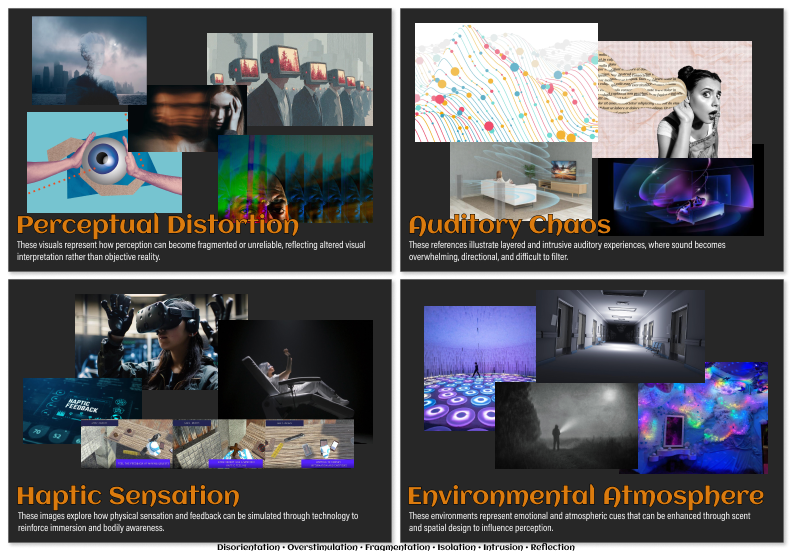
The early phases concentrated on concept development, emotional direction, and sensory research. Moodboards and brainstorming sessions were used to establish the atmosphere and emotional goals of the experience before any interface design began. During this phase, the project explored themes such as perceptual distortion, auditory overload, tactile immersion, and environmental atmosphere.
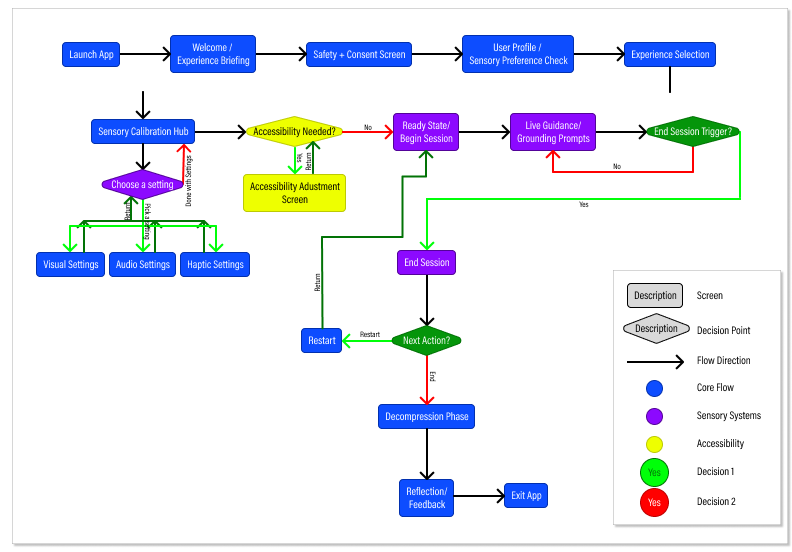
Once the emotional direction was established, the project transitioned into experience mapping and user flow development. This phase focused on structuring how users would move through onboarding, sensory calibration, accessibility configuration, guided immersion, and reflection.
The second phase of development focused on paper prototyping and low-fidelity wireframes. Since the assignment relied on traditional prototyping tools such as Figma, one of the biggest challenges became translating XR-oriented interactions into a structured 2D workflow. Special attention was given to readability, emotional pacing, accessibility, and reducing cognitive overload during navigation.
The final development phase focused on interactive prototyping and refining the overall user experience. The project evolved into a functioning prototype that simulated the onboarding and preparation process for a multi-sensory XR experience while maintaining accessibility, clarity, and emotional guidance throughout the interaction flow.
Throughout the project, iterative refinement played a major role in simplifying systems, clarifying navigation, and scaling the original concept into a realistic and achievable final product.
-
Project Overview
Research & Concept Development
Moodboard & Emotional Direction
Problem Statement & Hypothesis
User Flow Mapping
Paper Prototype Development
Low-Fidelity Wireframes
Accessibility Planning
Interactive Prototype Development
Emotional Pacing & User Guidance
Challenges & Iteration
Final Reflection
Skills Demonstrated
Week 1: RESEARCH & CONCEPT DEVELOPMENT
The earliest phase of the project focused on researching immersive sensory systems and defining how altered perception could be translated into an empathy-focused experience. Rather than approaching the project as entertainment, the goal was to create an experience that encouraged users to better understand the emotional and sensory instability that can accompany perceptual disorders.
Research explored several categories of immersive technology, including VR headsets, spatial audio systems, haptic feedback wearables, locomotion devices, and environmental sensory systems. Technologies such as the Oculus Quest 3, haptic vests, tactile gloves, and spatial sound systems helped shape the initial direction of the project.
However, the research phase also revealed a major challenge: building the entire XR environment itself would quickly push the project beyond the realistic scope of the assignment. This realization led to one of the most important pivots in the entire process.
Instead of designing the XR simulation directly, the project shifted toward designing the companion application responsible for guiding and configuring the experience. This adjustment preserved the original emotional vision while creating a much more achievable UX-focused project structure.
Client: Personal Project Project Date: October, 2026 School: Full Sail University Class: UXP3222-O
Problem & Hypothesis Definition
A detailed problem statement was created to articulate the challenges associated with designing immersive empathy-focused XR systems. Traditional educational methods often struggle to communicate what altered perception actually feels like because most explanations rely on description rather than experience.
At the same time, XR experiences involving sensory overload can quickly become inaccessible or emotionally unsafe without careful UX structure and accessibility support.
MOODBOARD & EMOTIONAL DIRECTION
Perceptual Distortion
Visual fragmentation, warped environments, duplicated imagery, and unreliable interpretation were used to represent instability in visual perception.
Auditory Chaos
Layered voices, directional sound overlap, and auditory interference explored how overwhelming sound environments can impact emotional state and focus.
Haptic Sensation
Wearable technology, environmental feedback systems, and tactile immersion represented the physical dimension of perception and bodily awareness.
Environmental Atmosphere
Fog, isolation, liminal environments, atmospheric lighting, and spatial ambiguity helped establish emotional tone and psychological tension.
Rather than designing for horror or shock value, the goal was to create emotional understanding through sensory discomfort, confusion, and overstimulation.
Week 1 Summary
By the end of Week 1, the project had established a clear emotional direction, a focused scope, and a structured UX strategy centered around accessibility and guided immersion. The project evolved from an overly ambitious XR systems concept into a focused companion application capable of supporting complex sensory experiences through thoughtful interface design.
The completed framing work established the foundation for all future design decisions and ensured that immersion, accessibility, and emotional pacing would remain aligned throughout the remainder of the project.
Problem Statement
How might we design a multi-sensory XR companion experience that allows users to safely explore altered perception while maintaining accessibility, emotional guidance, and user control throughout the experience?
Hypothesis
If users are given structured guidance, adjustable sensory calibration, and accessibility-focused support systems within a multi-sensory XR companion application, then they will be able to engage more safely and meaningfully with an immersive altered-perception experience. By combining controlled sensory interaction with clear UX design principles, the experience can increase empathy and understanding without sacrificing usability, comfort, or accessibility.
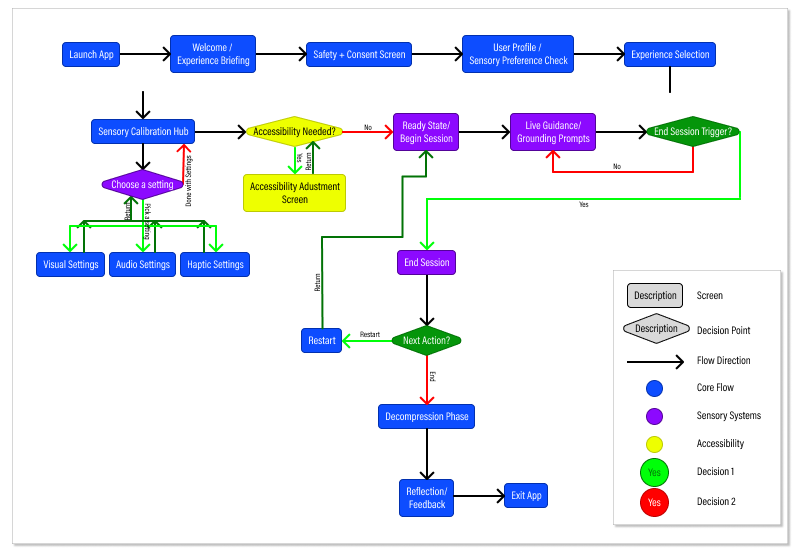
A complete user flow was created to guide the structure of the experience from onboarding to post-session reflection.
The flow included:
Welcome & briefing
Safety & consent
Experience selection
Sensory calibration
Accessibility configuration
Session readiness
Live guidance prompts
Reflection & decompression
Unlike traditional application flows focused solely on navigation efficiency, this flow was intentionally designed around emotional pacing and user comfort.
Decision points were incorporated throughout the experience to allow users to pause, adjust settings, or disengage if needed.
Here is how the proposal came out:
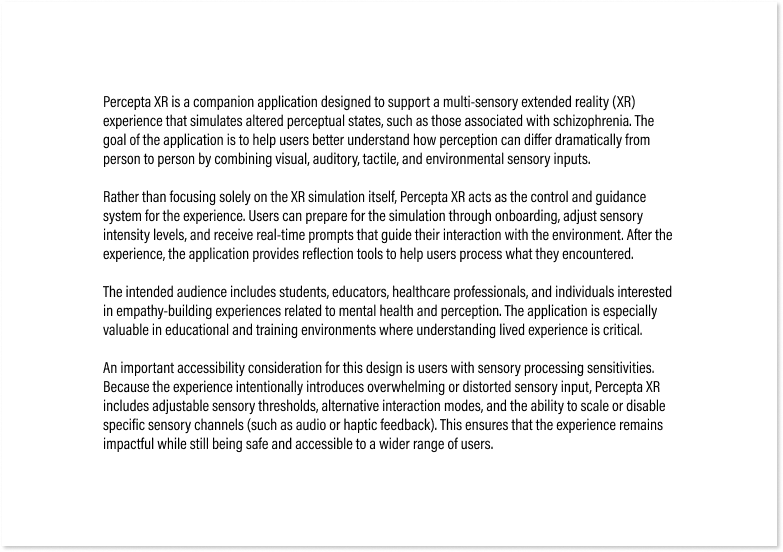
If you would prefer, you can download the whole proposal as a PDF here.
Week 2: IDEATION & PROTOTYPE PLANNING
LOW-FIDELITY WIREFRAMING
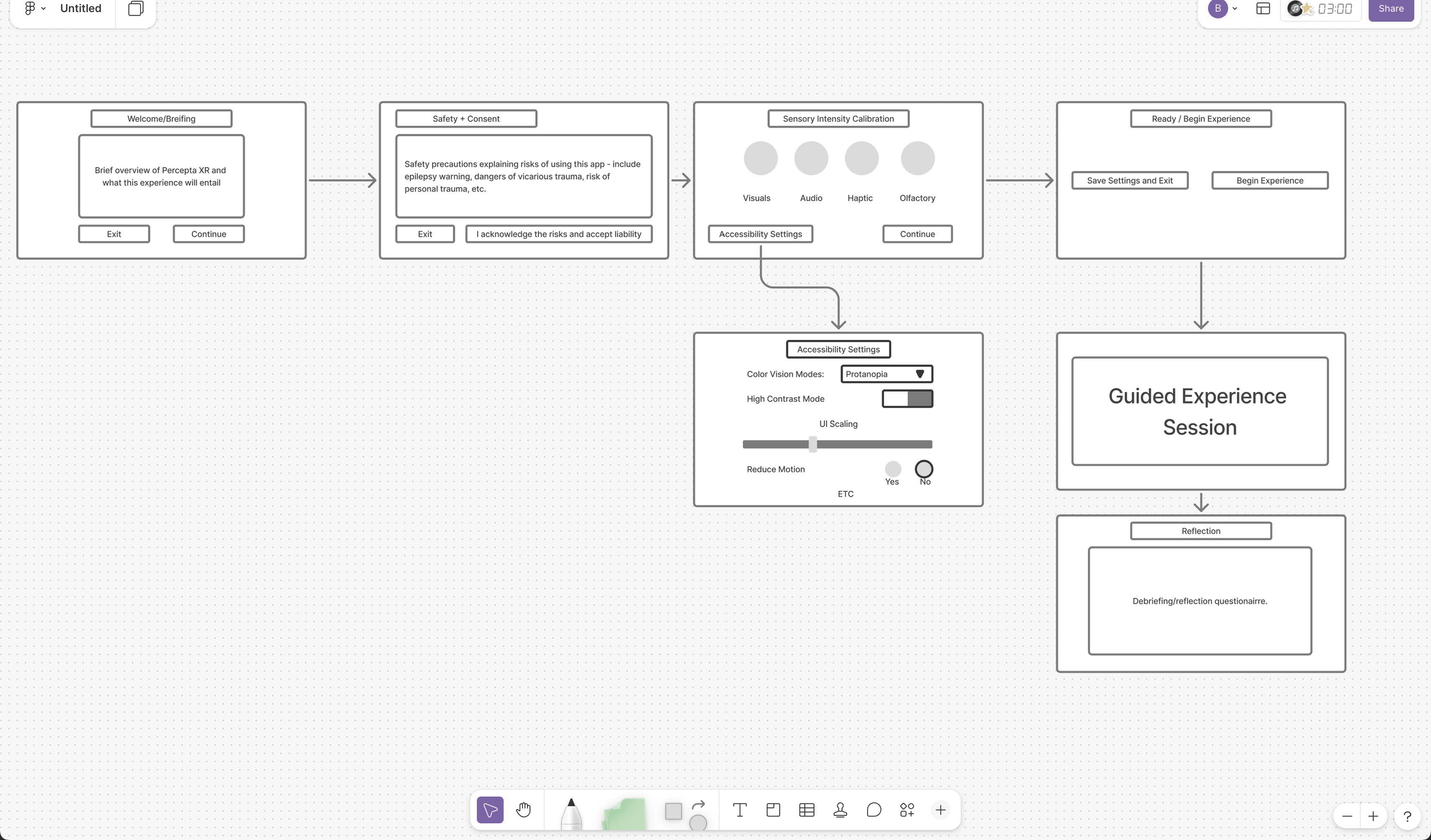
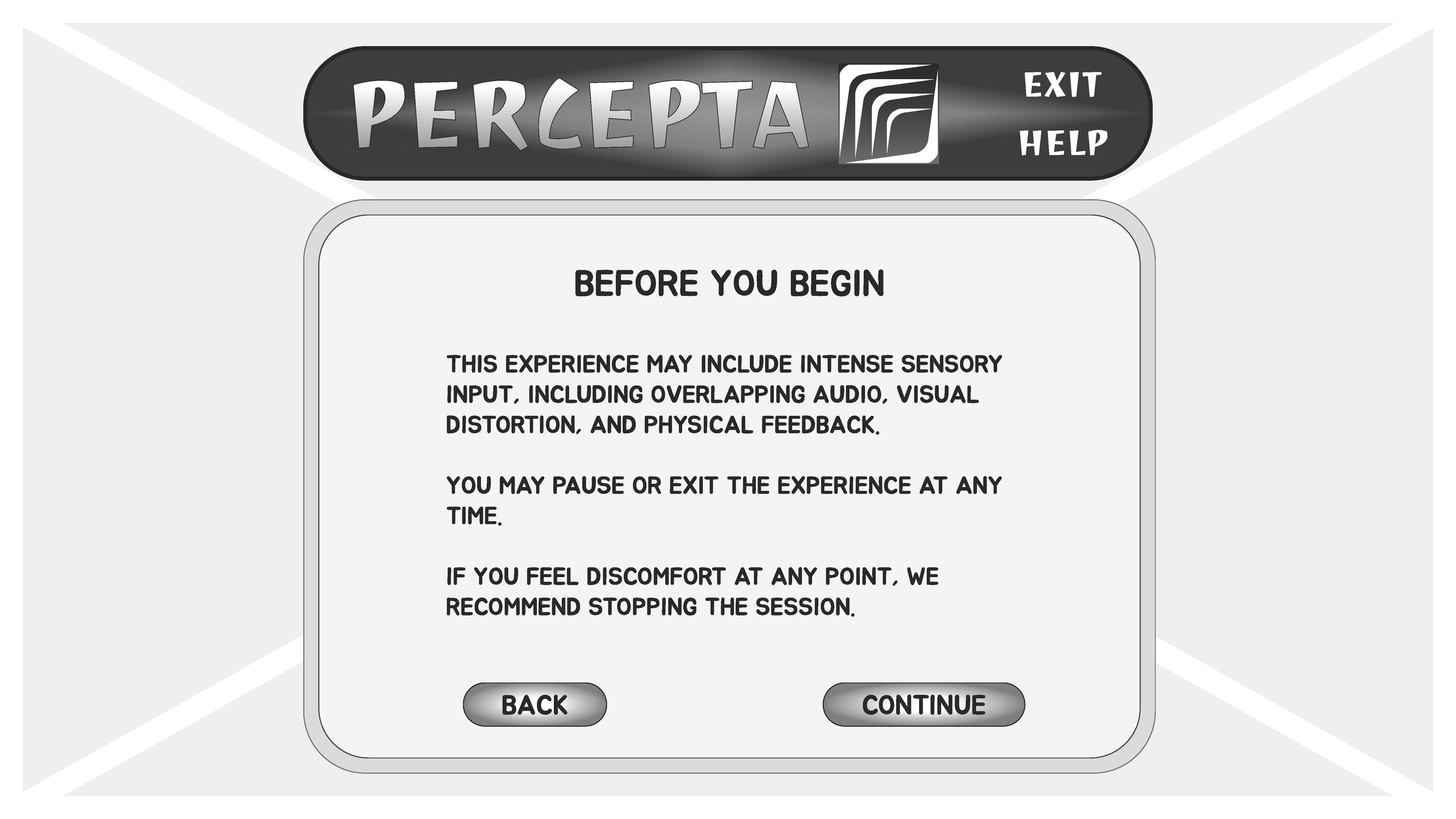
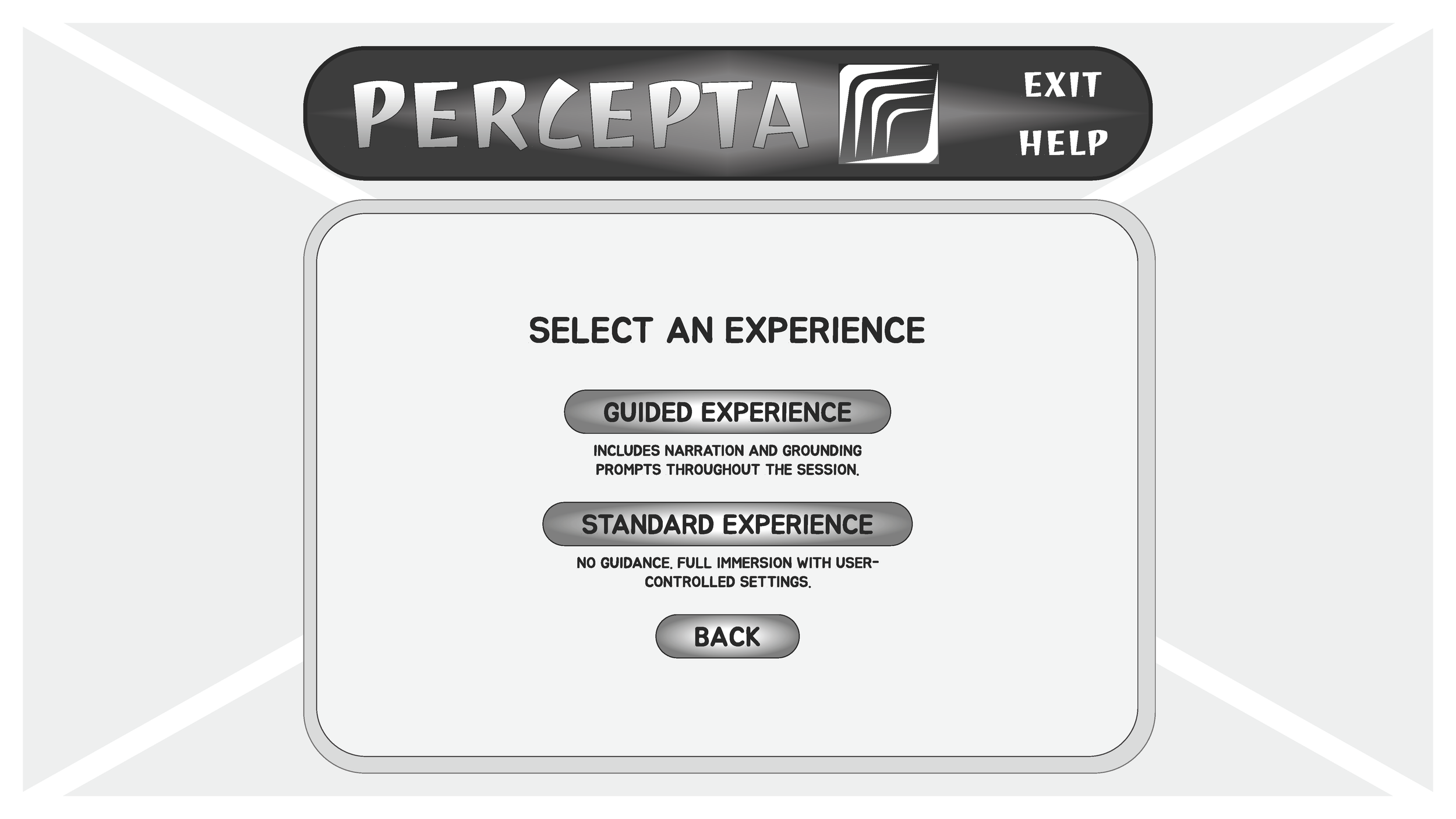
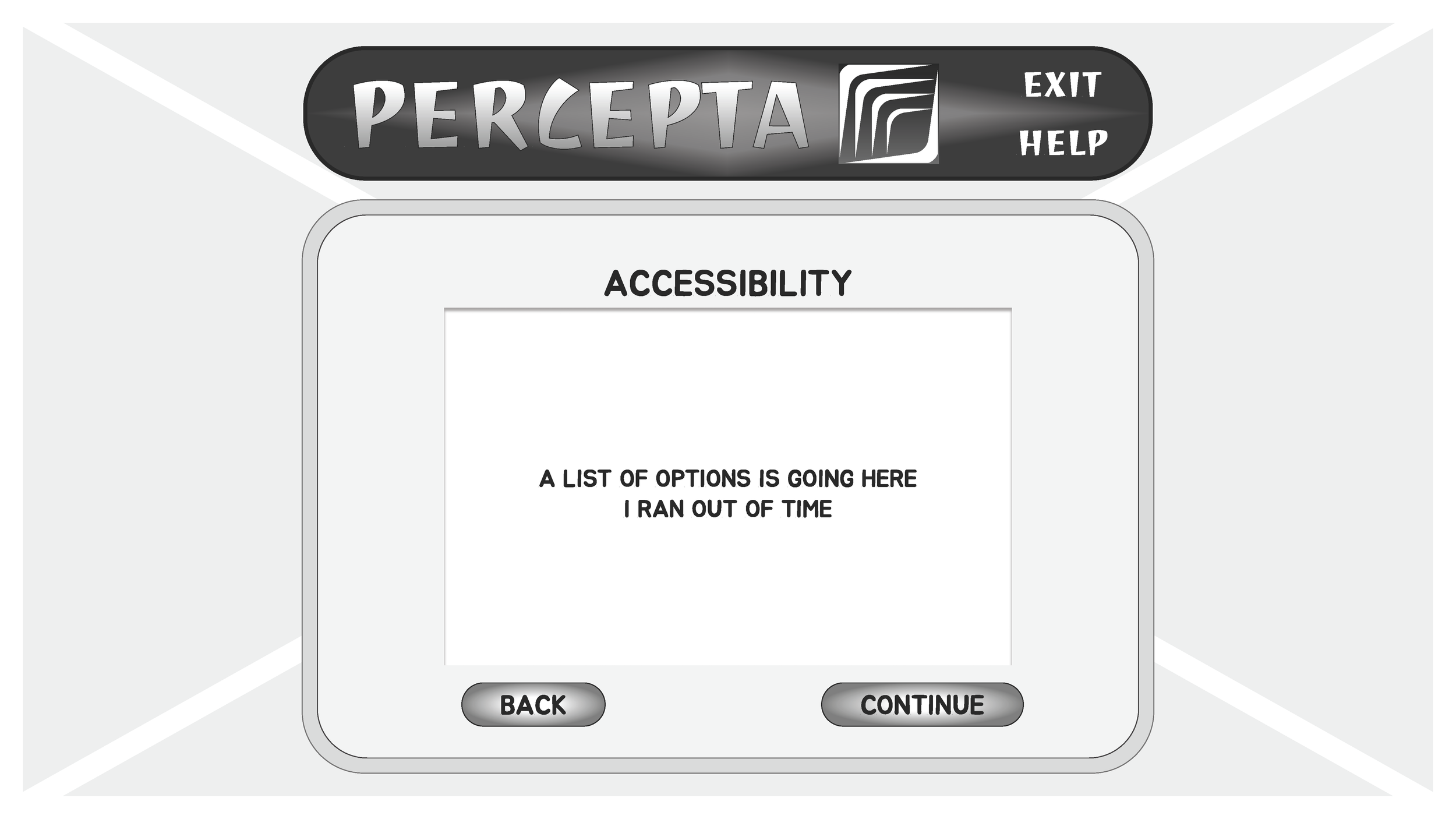
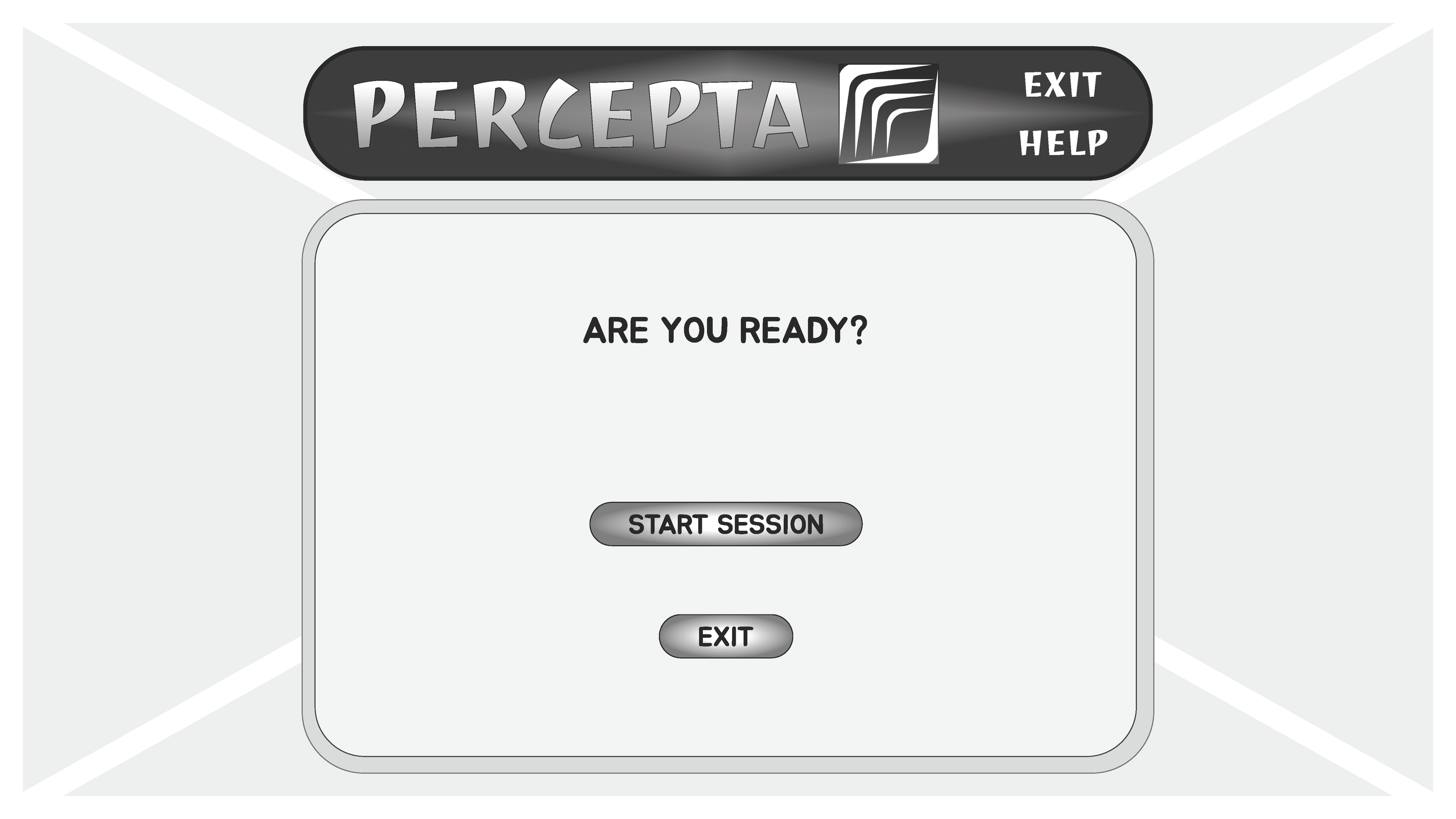
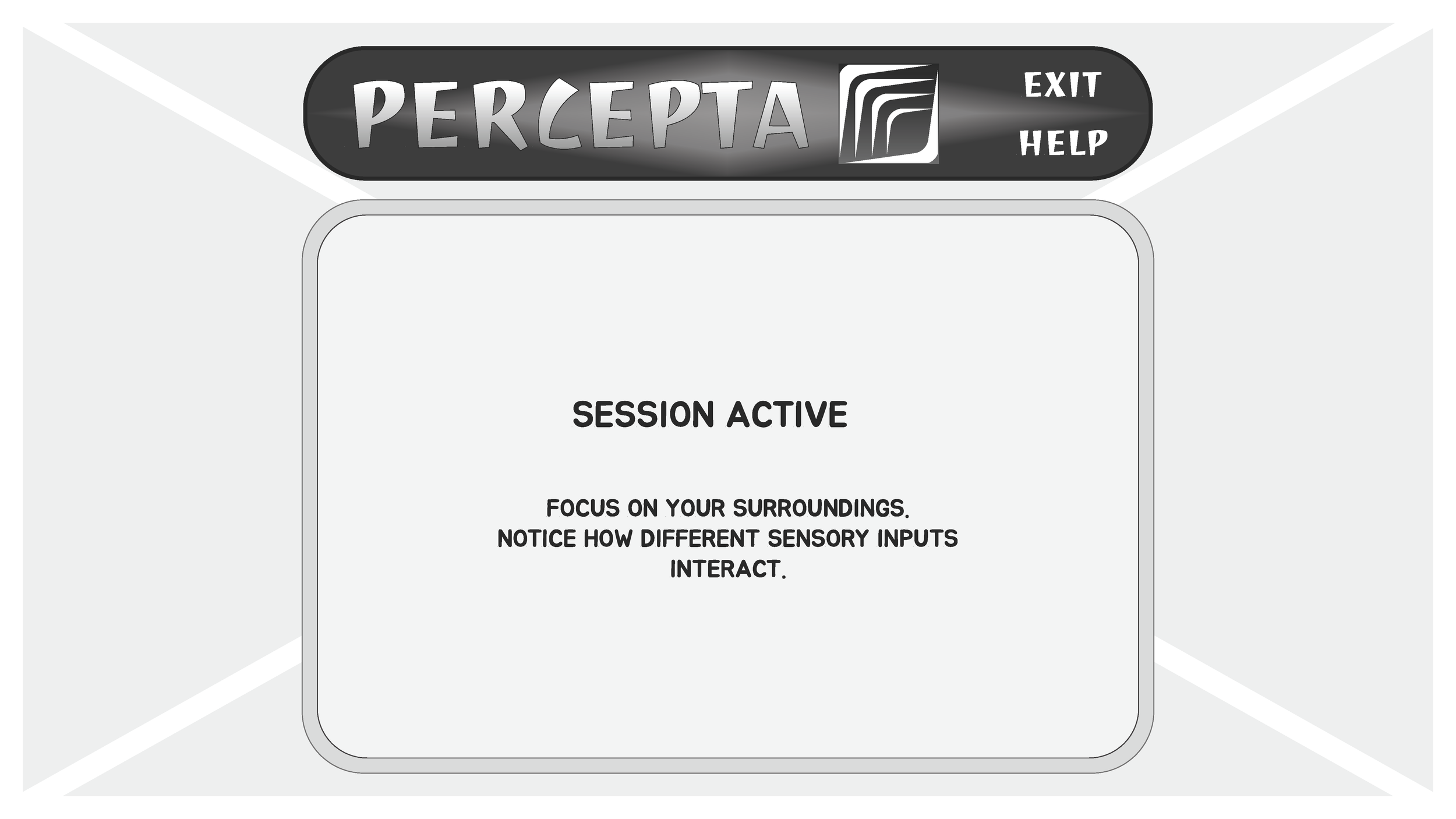
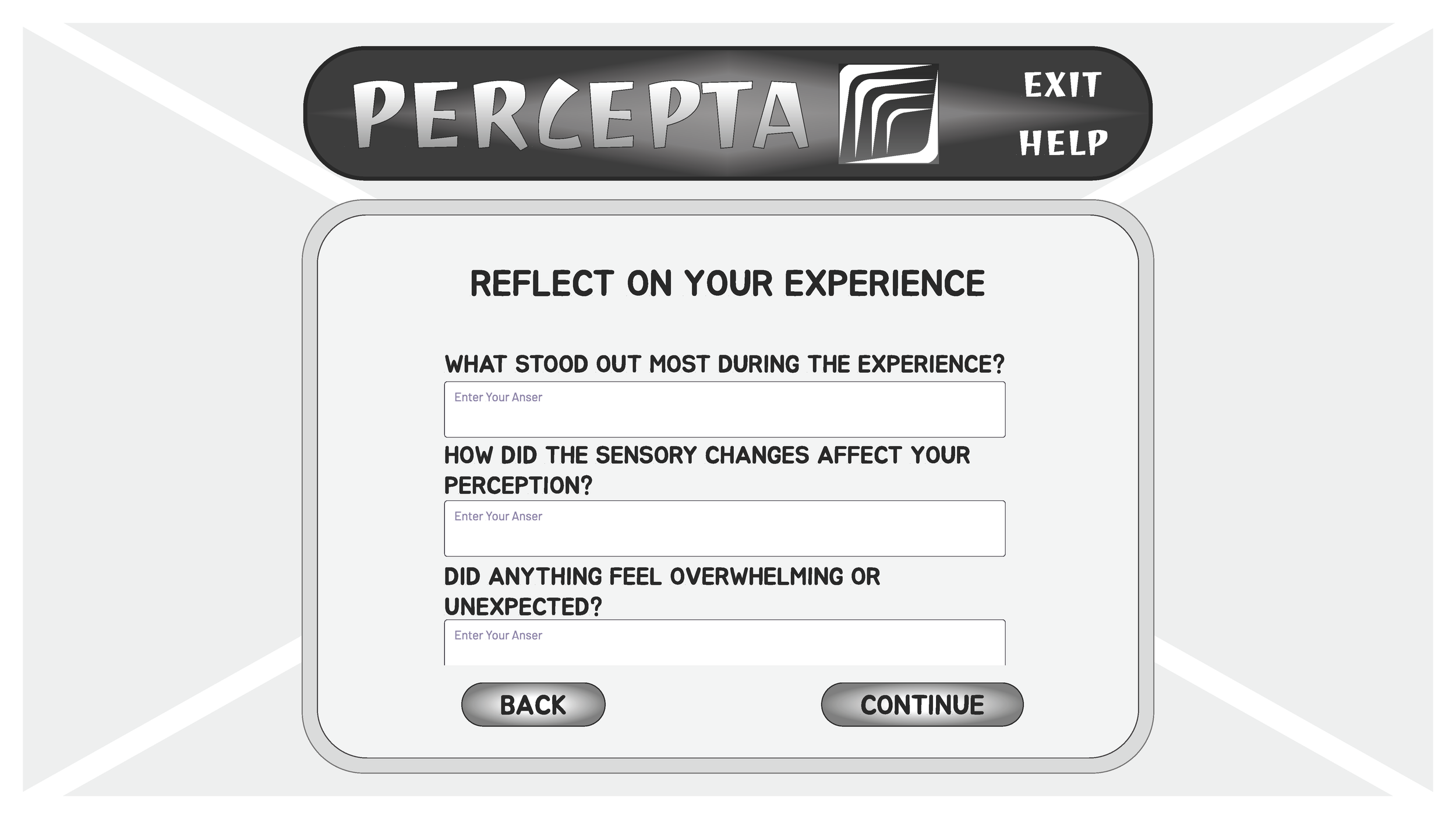
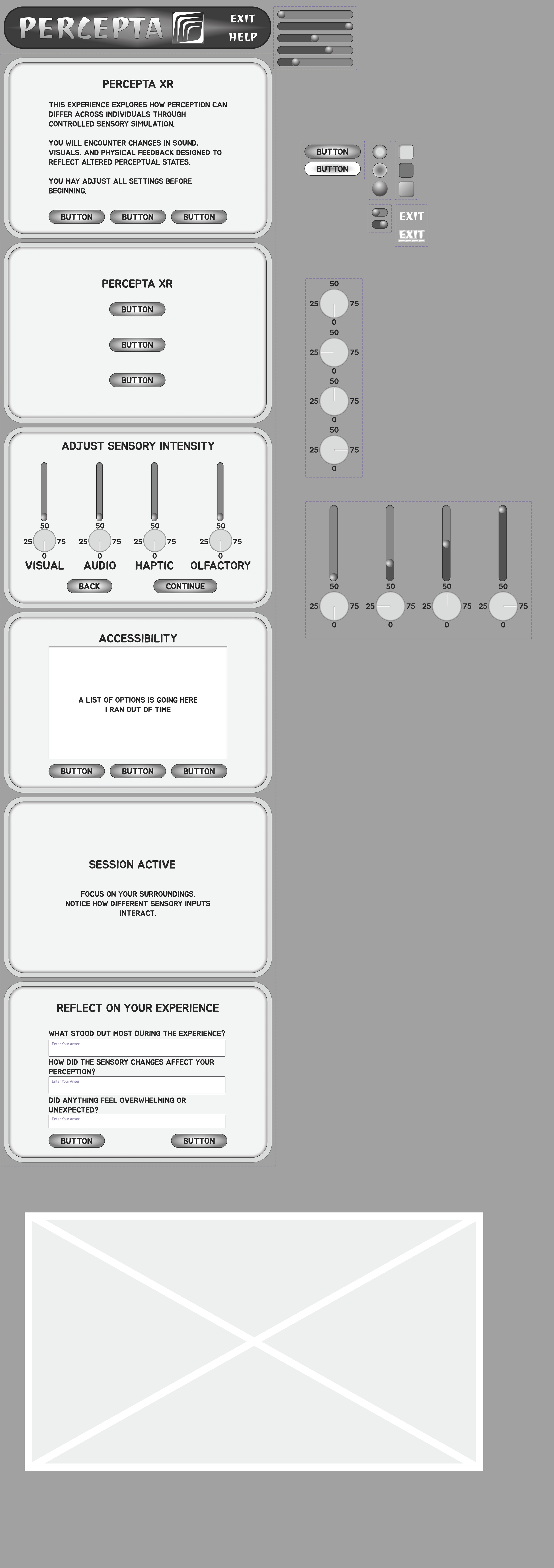
The wireframing phase focused on clarity, readability, and minimizing cognitive overload.
A 16:9 layout structure was used throughout the project to better align with common XR and VR interface presentation standards. This allowed screens to feel more naturally adaptable to immersive display environments.
Rather than relying on placeholder text, real copy was written during the wireframing stage to better evaluate pacing, emotional tone, and instructional clarity.
Special attention was given to:
Readability under sensory strain
Clear hierarchy
Simple navigation paths
Reduced visual clutter
Large interactive elements
Calm visual pacing
The goal was to create interfaces that felt supportive rather than overwhelming.
ACCESSIBILITY PLANNING
Accessibility became one of the defining pillars of the project.
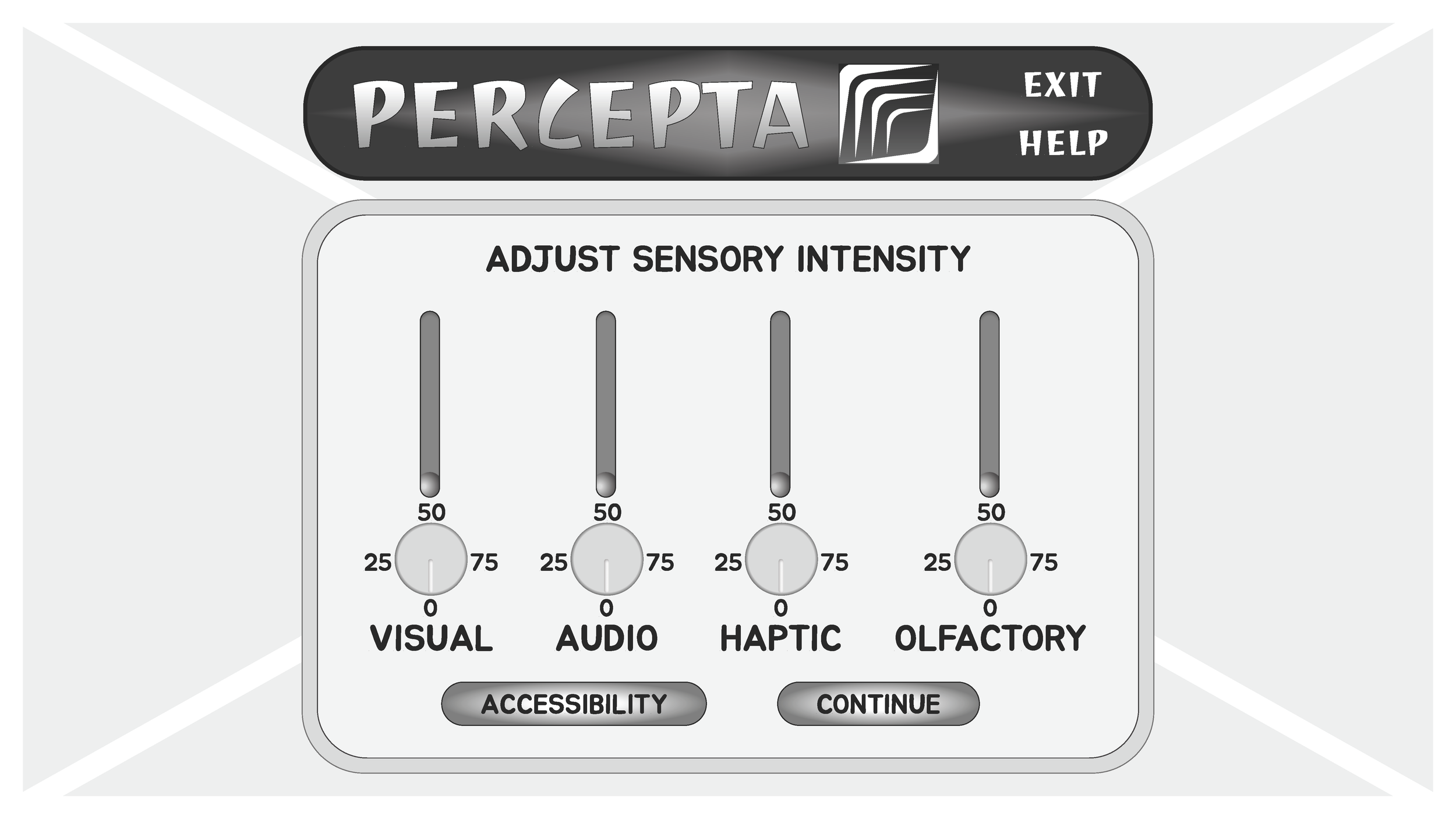
One of the most important design decisions involved separating sensory calibration systems from accessibility systems.
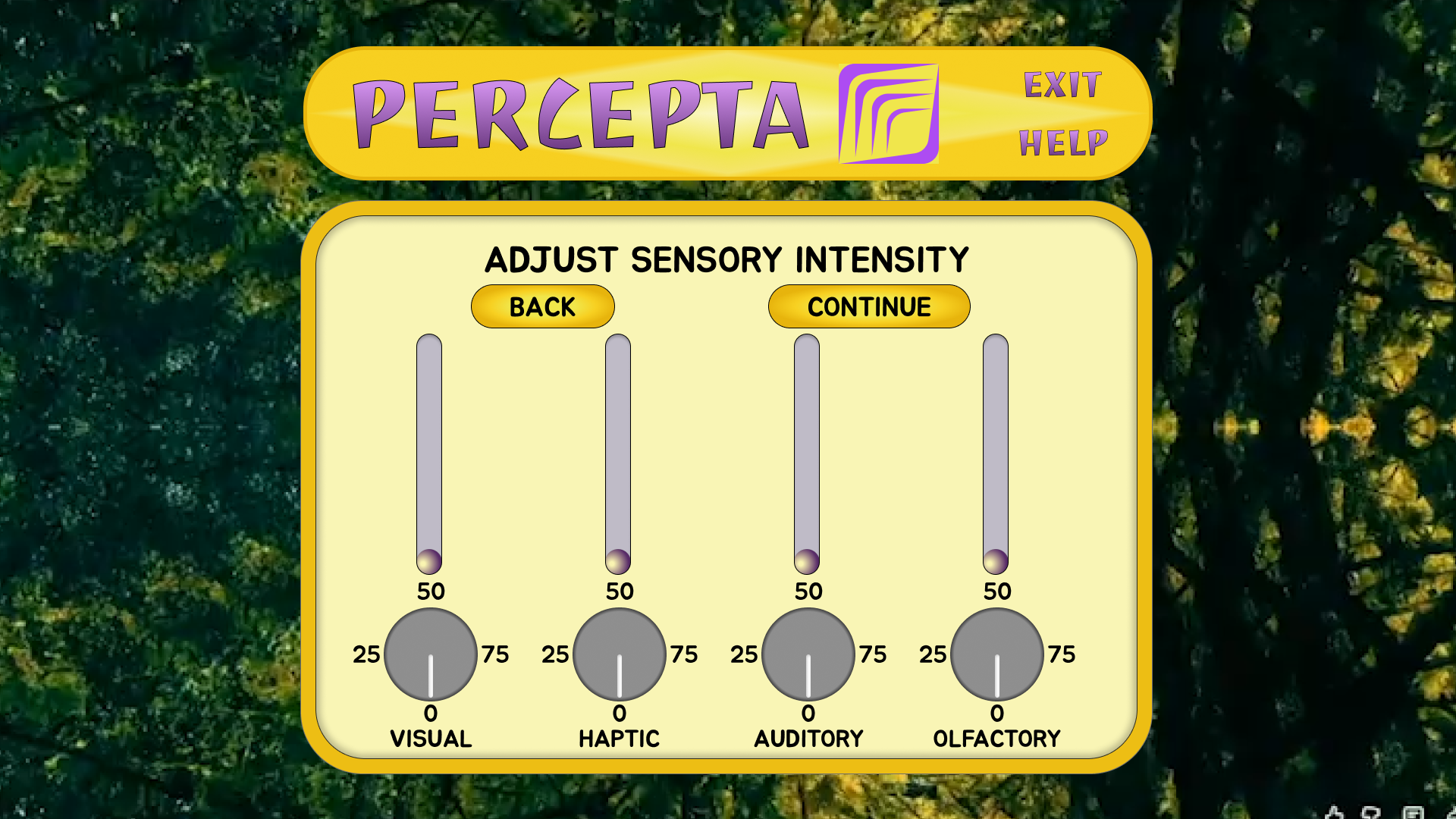
Sensory calibration focused on adjusting the intensity of the experience itself, including visual distortion, audio layering, haptic feedback, and environmental effects.
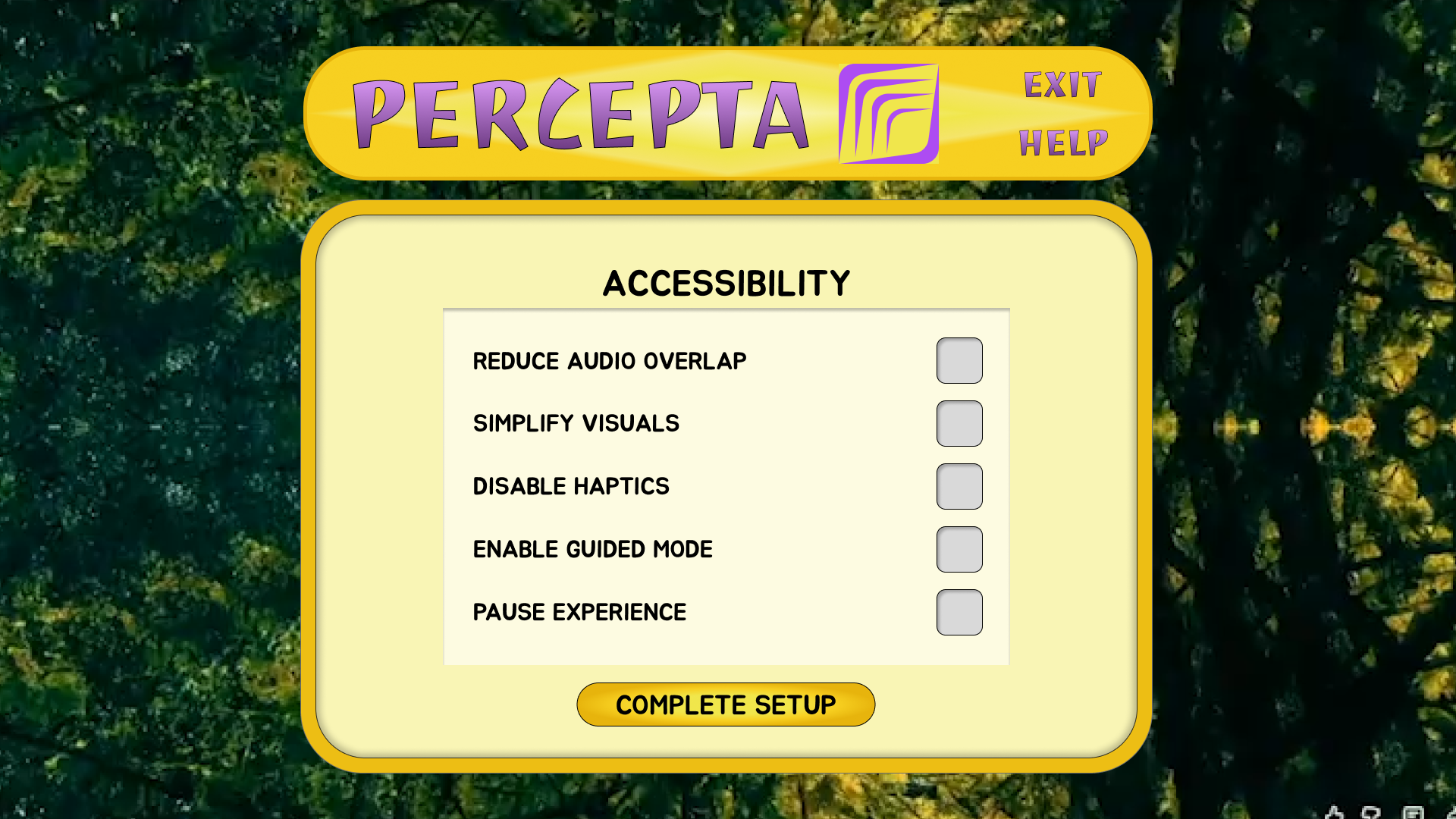
Accessibility systems focused instead on user capability and comfort. Features included:
Color correction modes
Voice navigation
Mono, stereo, and spatial audio selection
Simplified visual layouts
Cognitive support prompts
Persistent pause and exit systems
This separation allowed accessibility to remain focused on usability and inclusion rather than becoming tied directly to immersion intensity.
WEEK 3: INTERACTIVE PROTOTYPE DEVELOPMENT
Making it Real
Week 3 focused on transforming the planning and structural work from earlier phases into a functioning interactive prototype.
This phase emphasized interaction flow, emotional pacing, visual cohesion, and reinforcing the relationship between immersion and usability.
The prototype was developed entirely within Figma while maintaining design decisions intended to support XR-oriented presentation and interaction behavior.
INTERACTIVE PROTOTYPE DEVELOPMENT
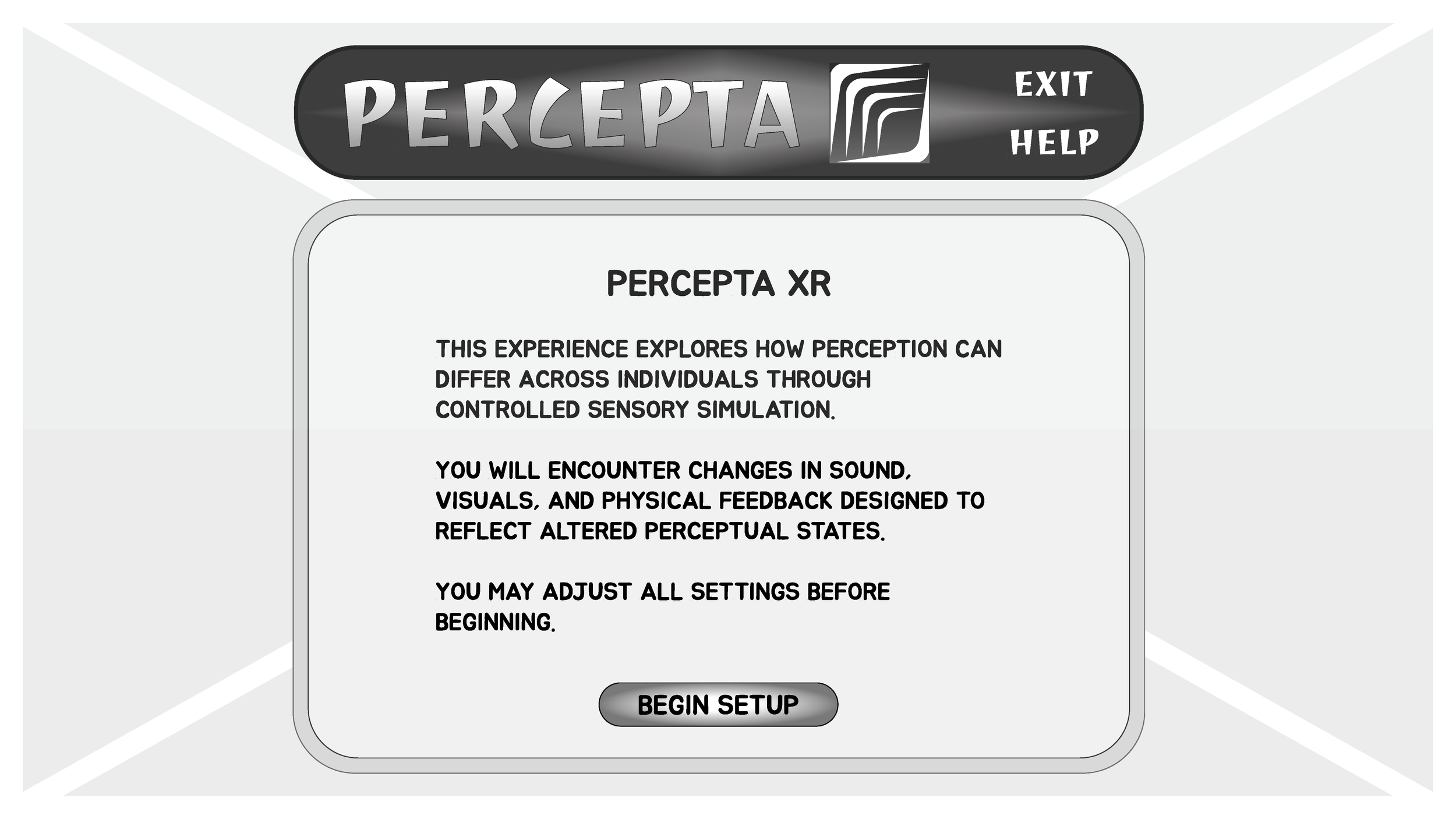
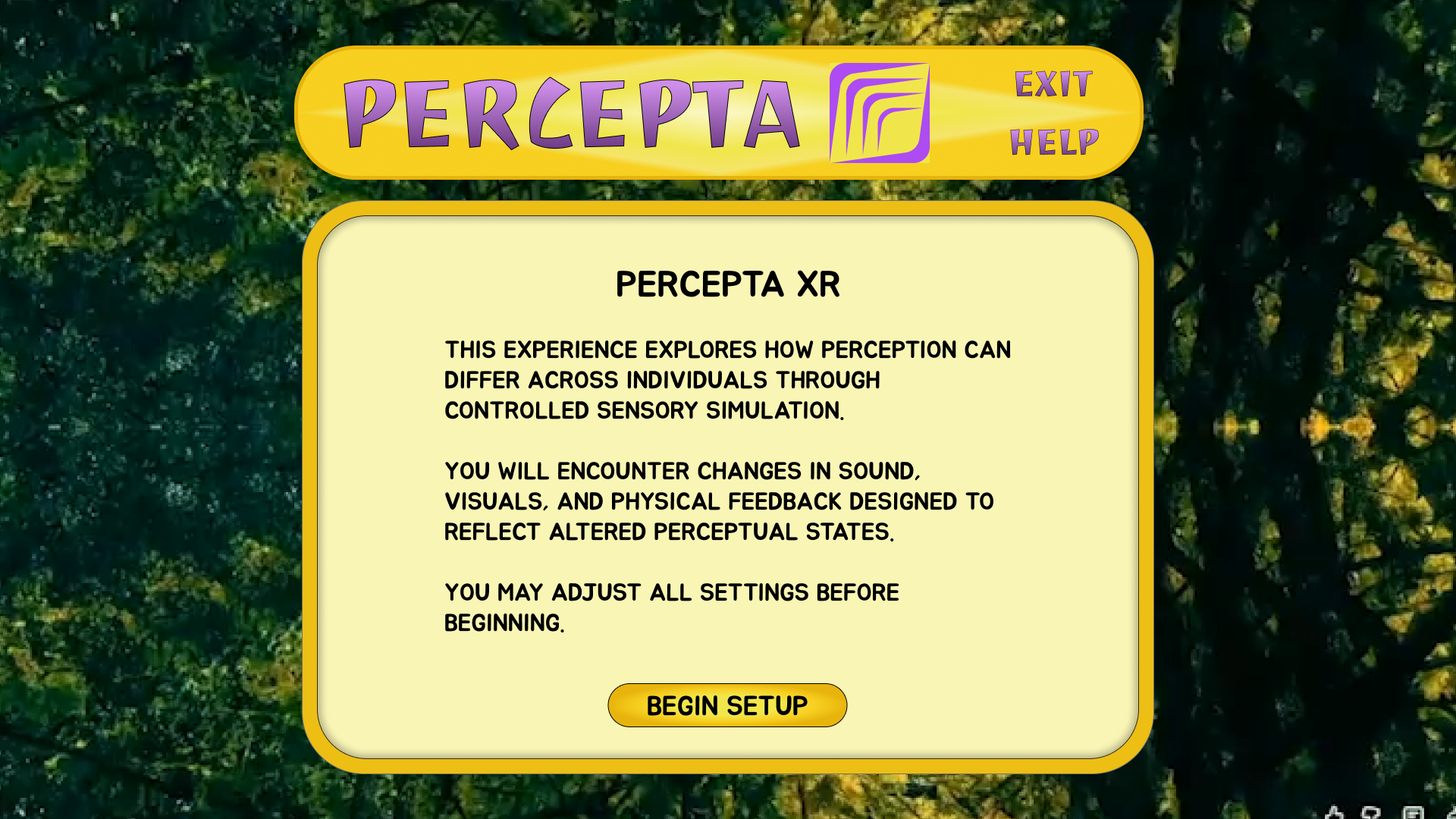
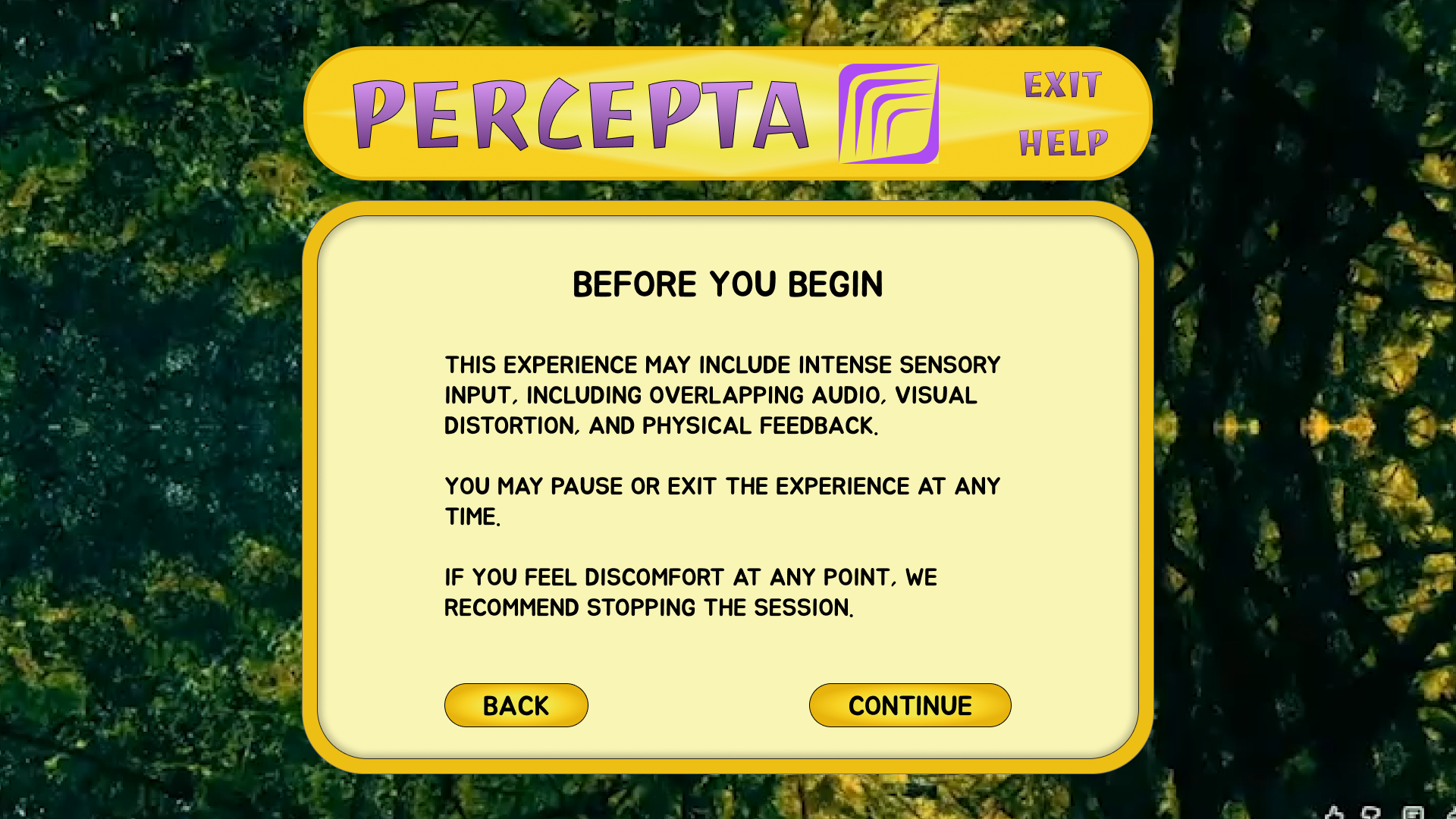
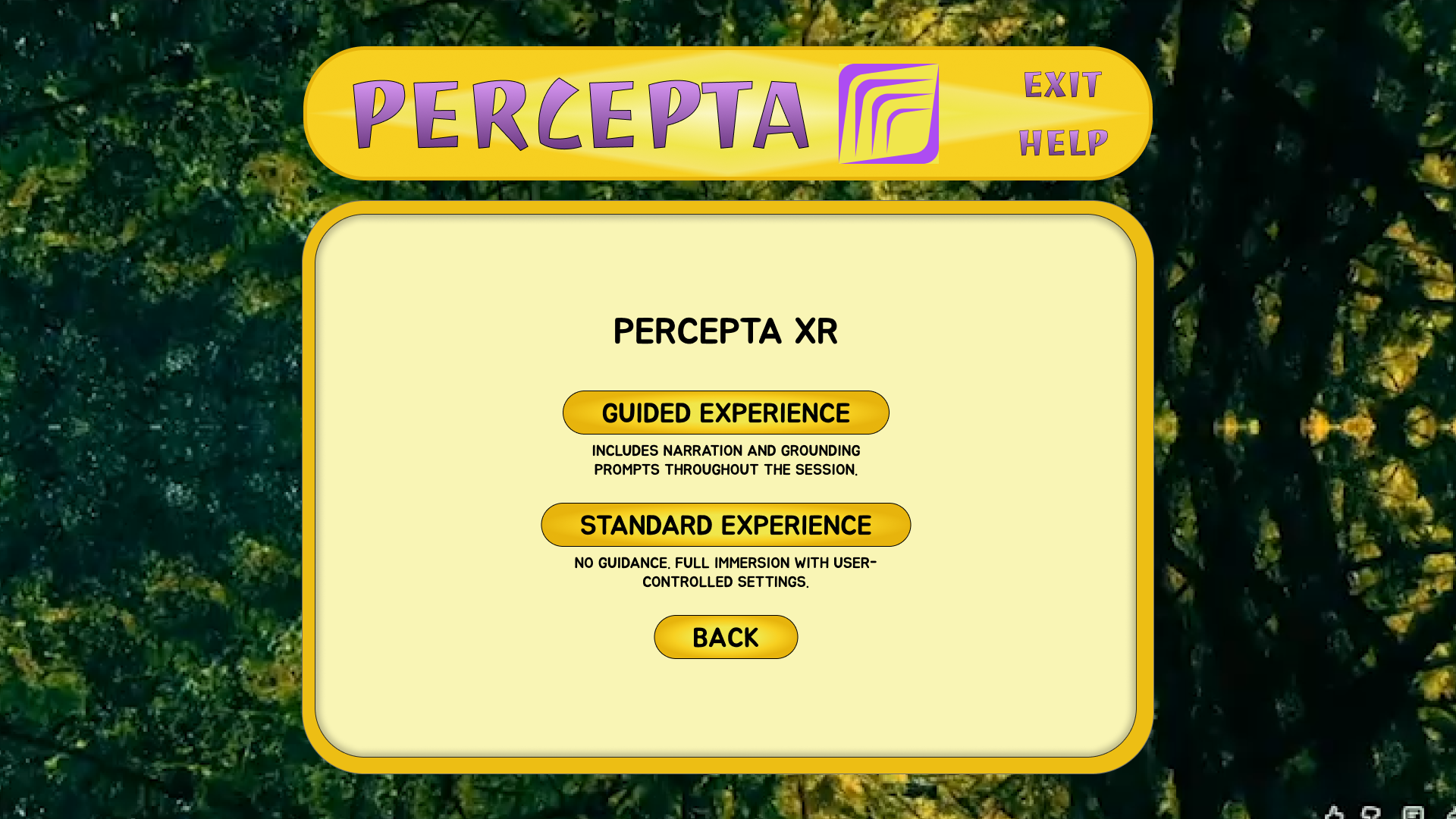
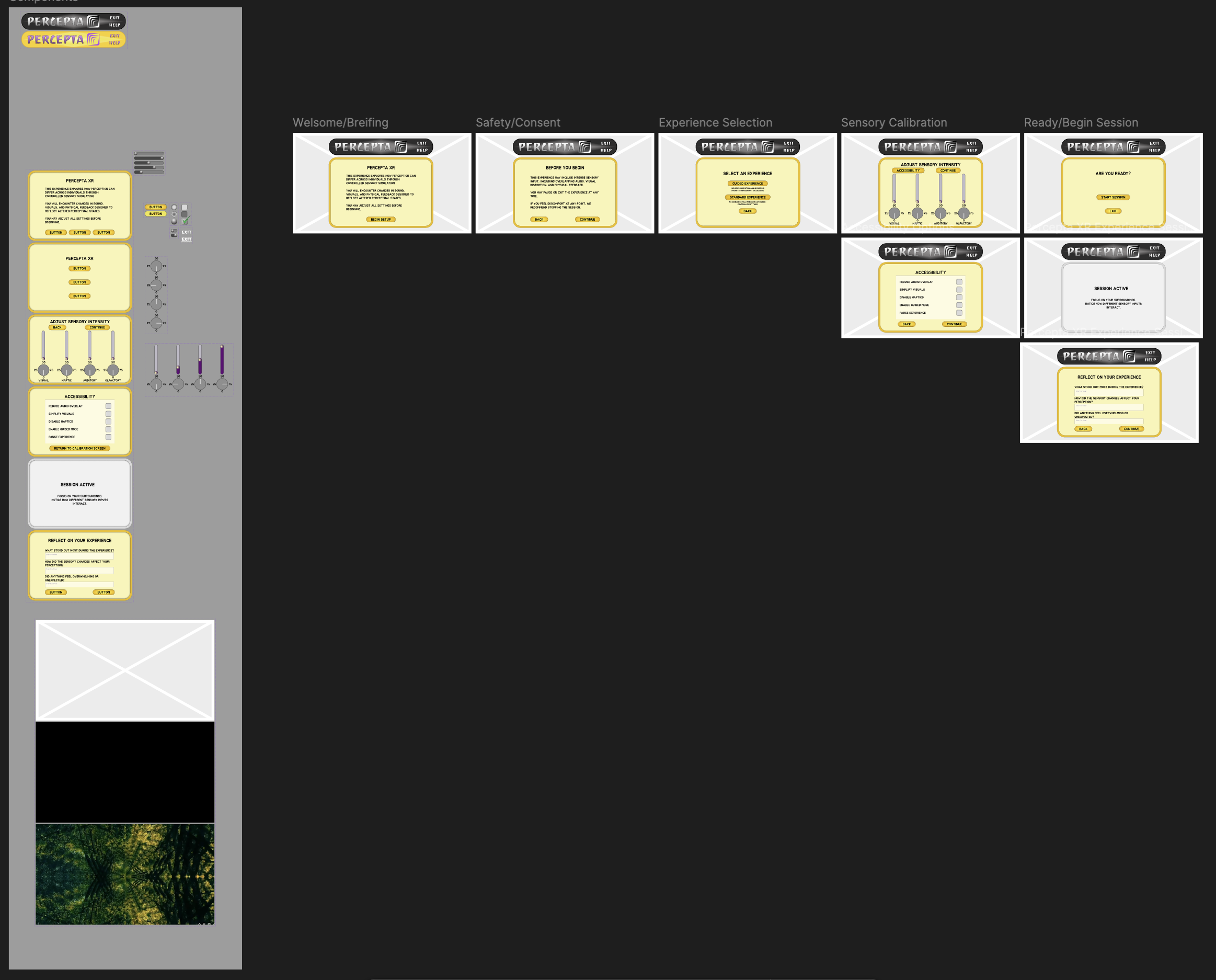
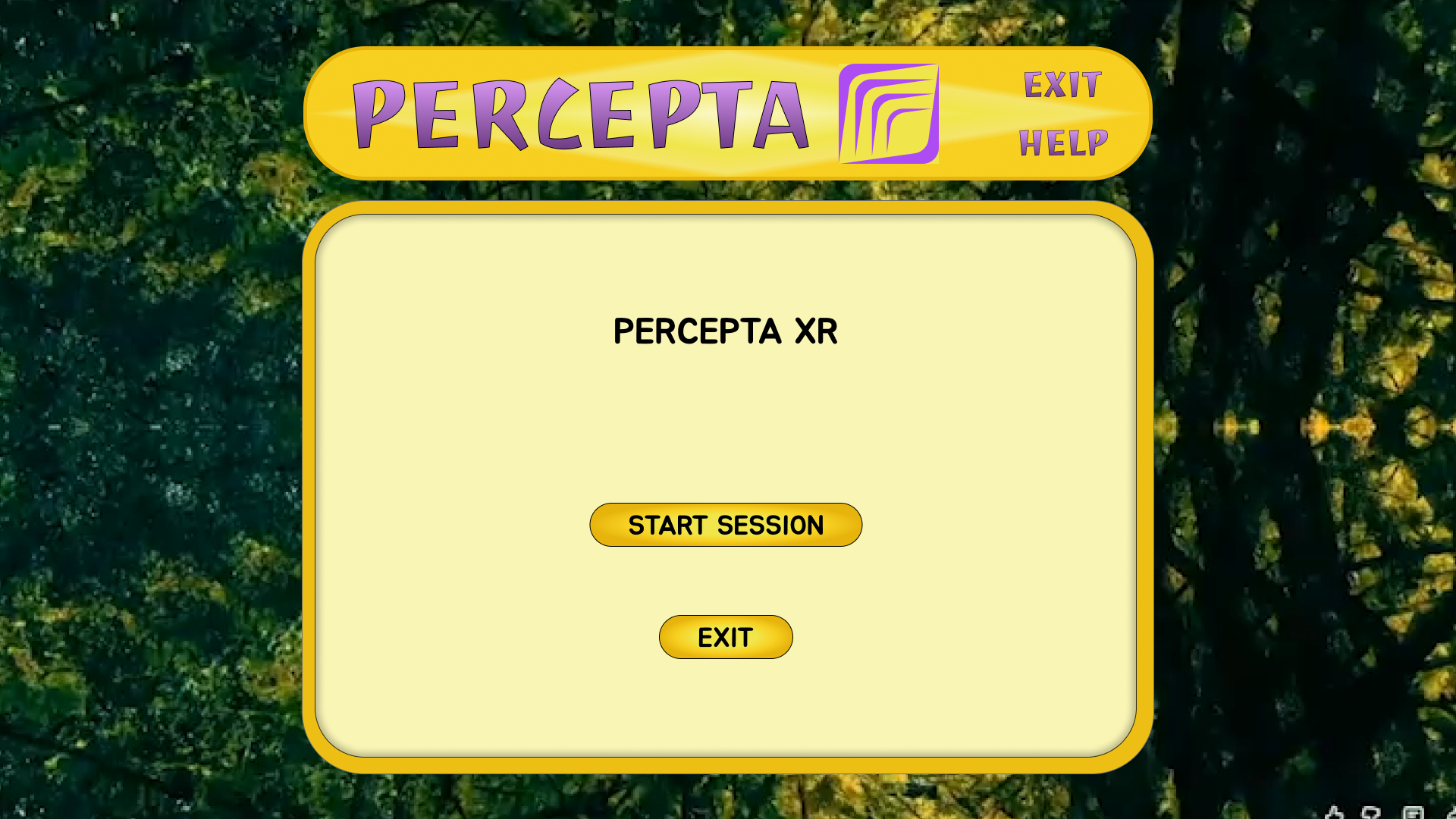
Using the low-fidelity wireframes and finalized user flow, a complete interactive prototype was constructed to simulate the onboarding and preparation process for the XR experience.
The prototype included:
Welcome and briefing screens
Safety and consent systems
Experience selection
Sensory calibration interfaces
Accessibility configuration
Ready-state onboarding
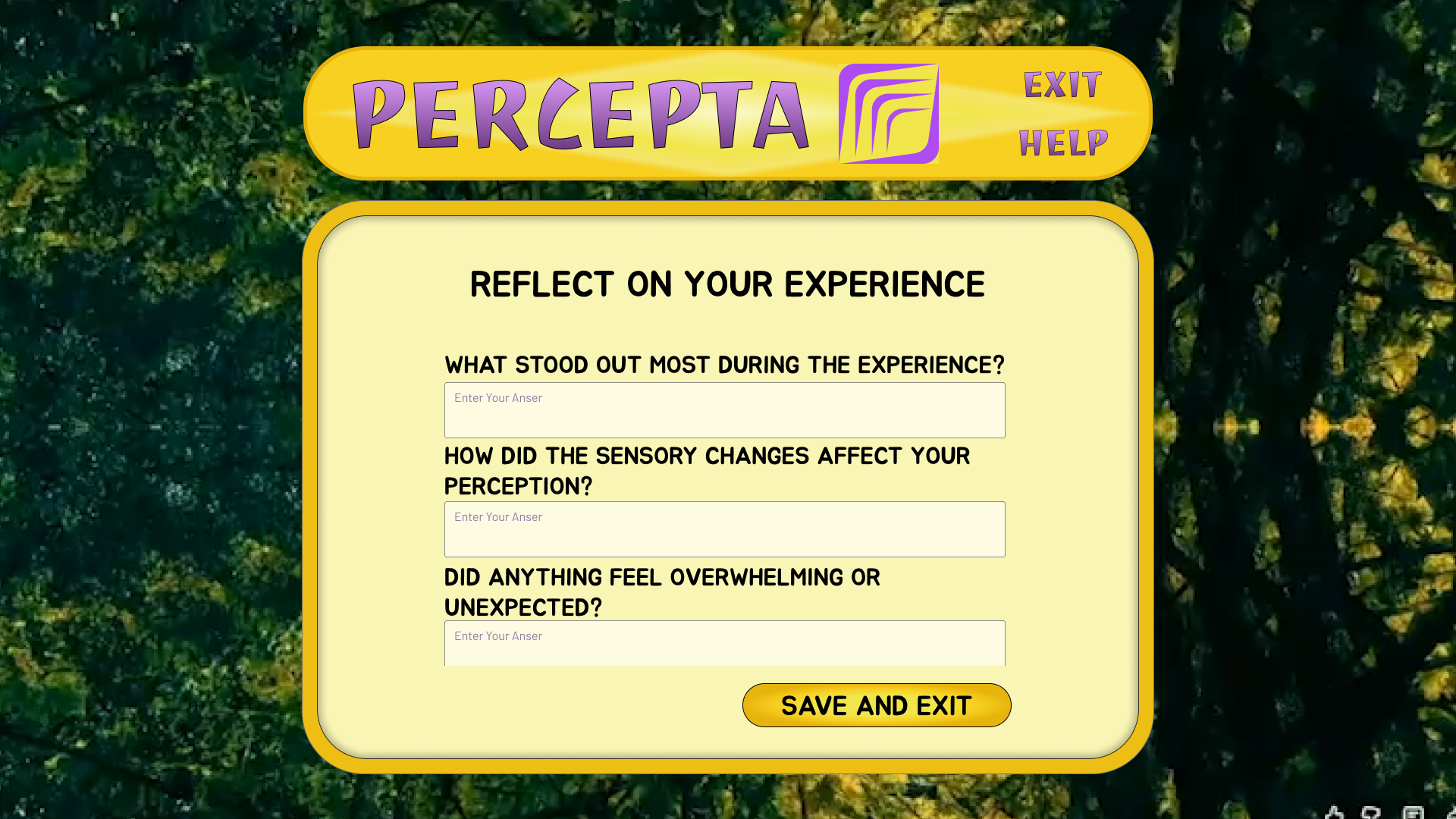
Reflection and decompression screens
Care was taken to ensure that interactions remained intentional, readable, and emotionally paced throughout the experience.
Navigation was deliberately kept simple and structured in order to reduce confusion and maintain focus during emotionally intense moments.
EMOTIONAL PACING & GUIDED EXPERIENCE DESIGN
Unlike many traditional UI systems focused purely on task completion, Percepta XR required emotional pacing to become part of the interaction design itself.
The onboarding sequence was intentionally designed to:
Prepare users emotionally
Establish safety expectations
Encourage intentional participation
Reinforce user control throughout the process
Reflection and decompression screens were also included to help users process the experience after completion rather than abruptly ending the interaction.
This structure reinforced the educational and empathy-focused goals of the project while helping maintain emotional safety.
Week 3 Summary
By the end of Week 3, Percepta XR existed as a cohesive interactive prototype capable of guiding users through a structured, accessibility-aware XR onboarding experience. The project successfully demonstrated how UX systems can support emotionally intense immersive experiences through thoughtful pacing, calibration systems, and user-centered accessibility planning.

Case Study Summary
Percepta XR began as an ambitious concept exploring altered perception through immersive multi-sensory XR design. Over the course of the project, that concept evolved into a focused UX companion platform centered around guidance, accessibility, emotional pacing, and sensory control.
Rather than attempting to recreate perception disorders directly, the project focused on how interface design can support empathy-building experiences safely and intentionally.
Throughout the four-week process, each phase intentionally built upon the last. Early concept framing established the emotional goals and experiential direction of the project. Moodboarding and sensory exploration defined the tone of the experience, while user flows and wireframes translated abstract concepts into structured interaction systems. The final prototype brought those systems together into a cohesive onboarding and calibration experience designed to support immersive XR interaction while maintaining accessibility and emotional awareness.
One of the most valuable lessons of the project involved scope management. Learning to scale the concept from a full XR environment into a realistic UX companion platform allowed the project to remain achievable while preserving its original vision and intent.
Percepta XR ultimately reinforced the importance of designing systems, not just screens. By prioritizing accessibility, emotional pacing, and user control alongside immersion, the project demonstrates how thoughtful UX design can support complex experiential technologies in meaningful and human-centered ways.