A case study of my ui/ux design process
Project: Boo Boo Heroes
-
Boo Boo Heroes began with a simple question: how can first-aid learning feel less scary and more supportive for parents? Small injuries are a normal part of family life, but in the moment, uncertainty can quickly turn into stress. Created in collaboration with Keep Going First Aid, this project explores how a playful, game-based experience can turn those moments into opportunities for calm, confident action. This case study tells the story of designing a first-aid learning game that prioritizes reassurance, clarity, and approachability over urgency or fear.
-
At the heart of this project are parents and caregivers navigating busy, unpredictable days. They care deeply about their children’s safety, yet often feel unsure when something goes wrong. Through research and persona development, I focused on understanding not just what parents need to know, but how they feel in those moments… rushed, worried, and eager for clear guidance. Those emotional insights shaped every design decision, from the tone of the language to the pacing of interactions, ensuring the experience supports parents without talking down to them.
-
This project unfolded as an iterative journey, moving from early discovery into research, ideation, and prototyping. Each phase informed the next, allowing ideas to evolve as new insights surfaced. Rather than aiming for a perfect solution from the start, the process emphasized learning, refinement, and intentional decision-making. This case study follows that path, highlighting how research insights translated into structure, how concepts became interactions, and how the final prototype emerged through thoughtful UX and UI exploration.
-
Week 1: Discover / Project framing
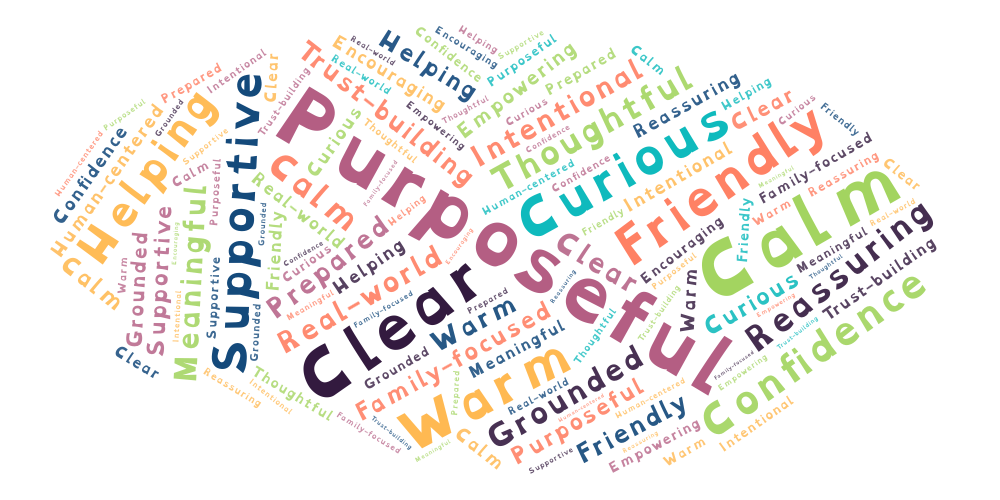
Week 1 focused on establishing a clear foundation for the project through the creation of a formal project proposal. This phase defined the scope, goals, audience, and design approach for Boo Boo Heroes, ensuring alignment between user needs, first-aid best practices, and the Keep Going First Aid brand before any design work began.
Client
Keep>Going First Aid
Project Date:
December, 2025
School
Full Sail University
Class
UXP119-O
Project Framing & Collaboration
The proposal formally established the collaboration with Keep Going First Aid, grounding the project in their mission to empower parents with confidence, clarity, and calm during everyday emergencies. Brand values, tone, and visual identity considerations were documented early to ensure the game would feel supportive and family-friendly rather than clinical or intimidating
Problem & Hypothesis Definition
A detailed problem statement was developed to articulate the emotional and practical challenges parents face when responding to minor injuries. The proposal identified gaps in first-aid confidence, inconsistent knowledge retention, and anxiety caused by uncertainty. From this, a hypothesis was defined.
Value Proposition & Learning Approach
The proposal outlined the core value proposition of transforming first-aid education into a low-pressure, interactive experience. By framing learning through micro-games, adventure-style scenarios, and the Check → Call → Care sequence, Boo Boo Heroes positions itself as a reassuring “pocket resource” rather than a one-time training tool. This approach emphasizes repetition, clarity, and emotional reassurance to support long-term skill retention
Process Planning & Deliverables
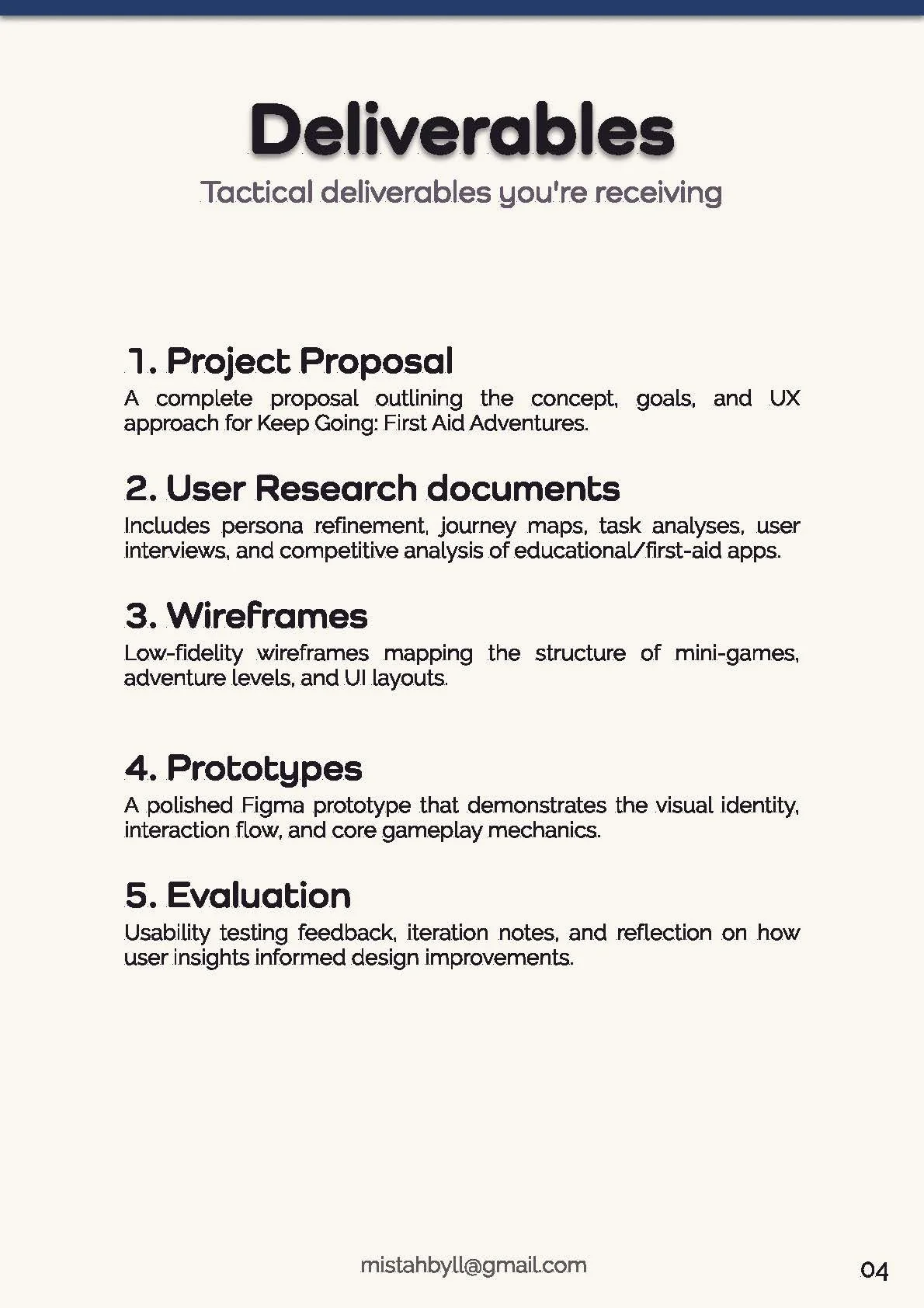
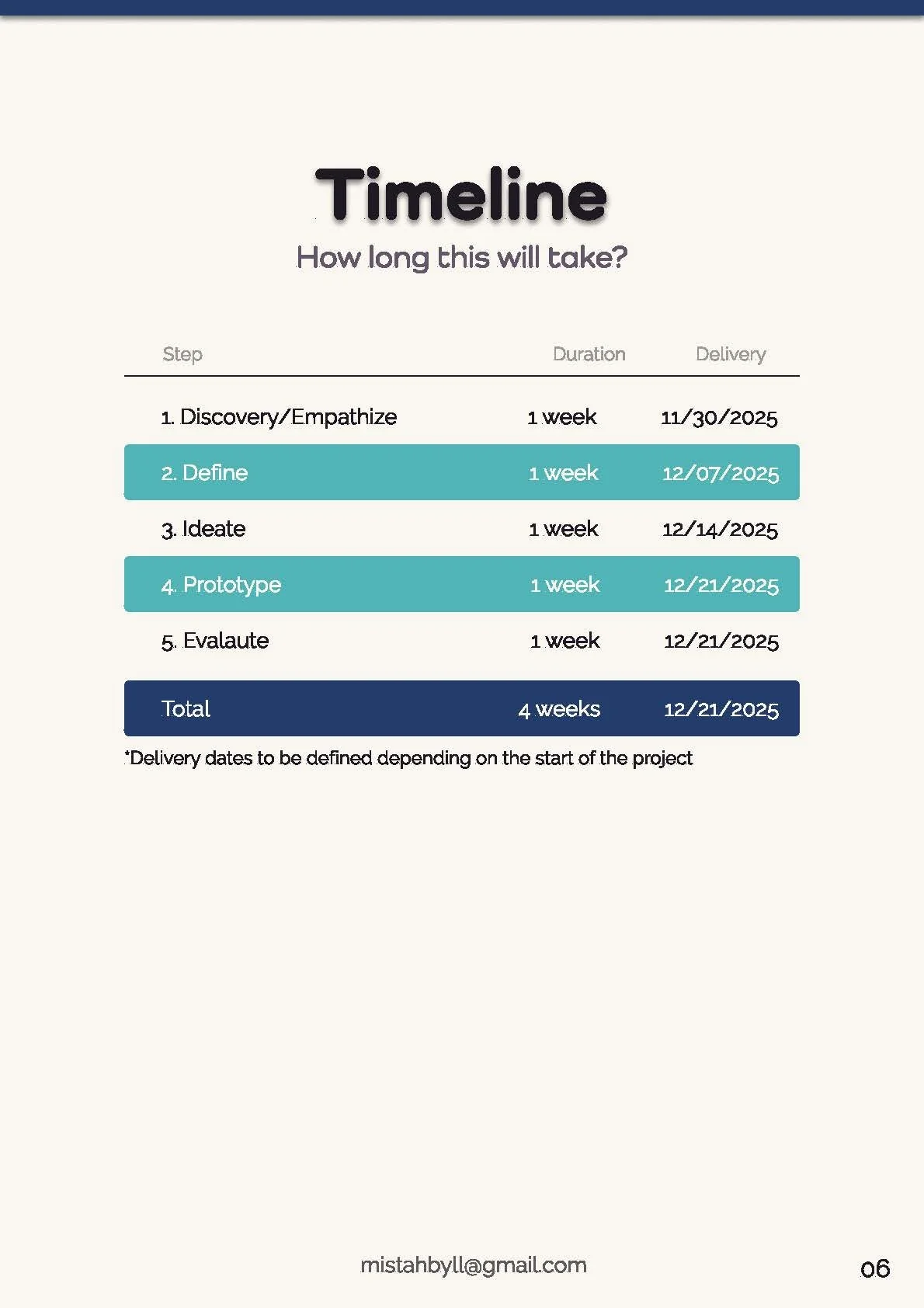
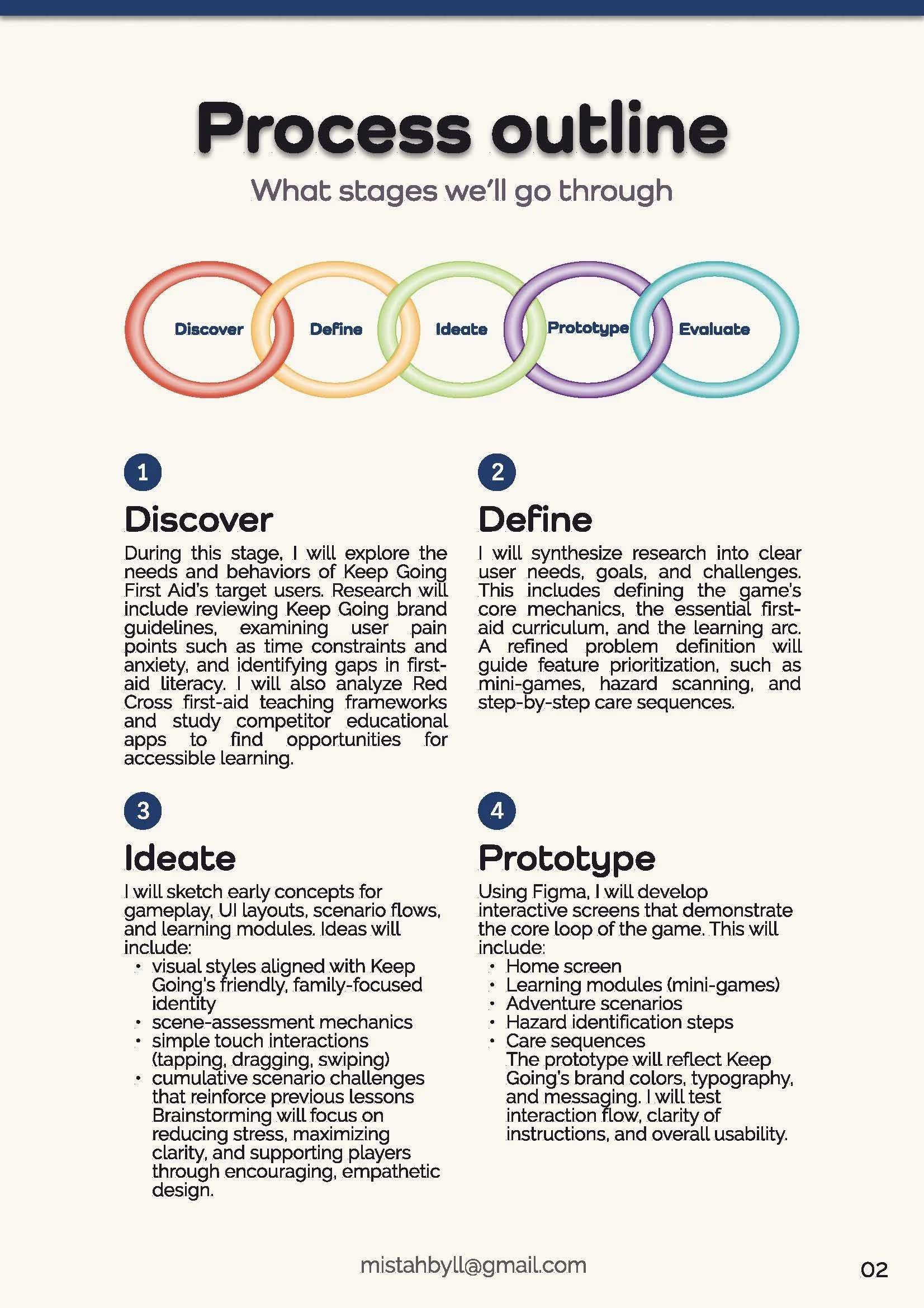
Week 1 also defined the full design process and timeline for the project. The proposal mapped out each phase—Discover, Define, Ideate, Prototype, and Evaluate—and specified expected deliverables, including research documentation, wireframes, prototypes, and usability evaluation. This planning ensured the remaining weeks could focus on execution while staying aligned with clearly articulated goals and constraints
Week 1 Summary
By the end of Week 1, the project had a validated direction, a documented learning philosophy, and a clear roadmap for execution. The completed proposal served as the strategic anchor for all subsequent research, ideation, and prototyping work, reducing ambiguity and aligning stakeholders before moving into deeper UX exploration.
Problem Statement
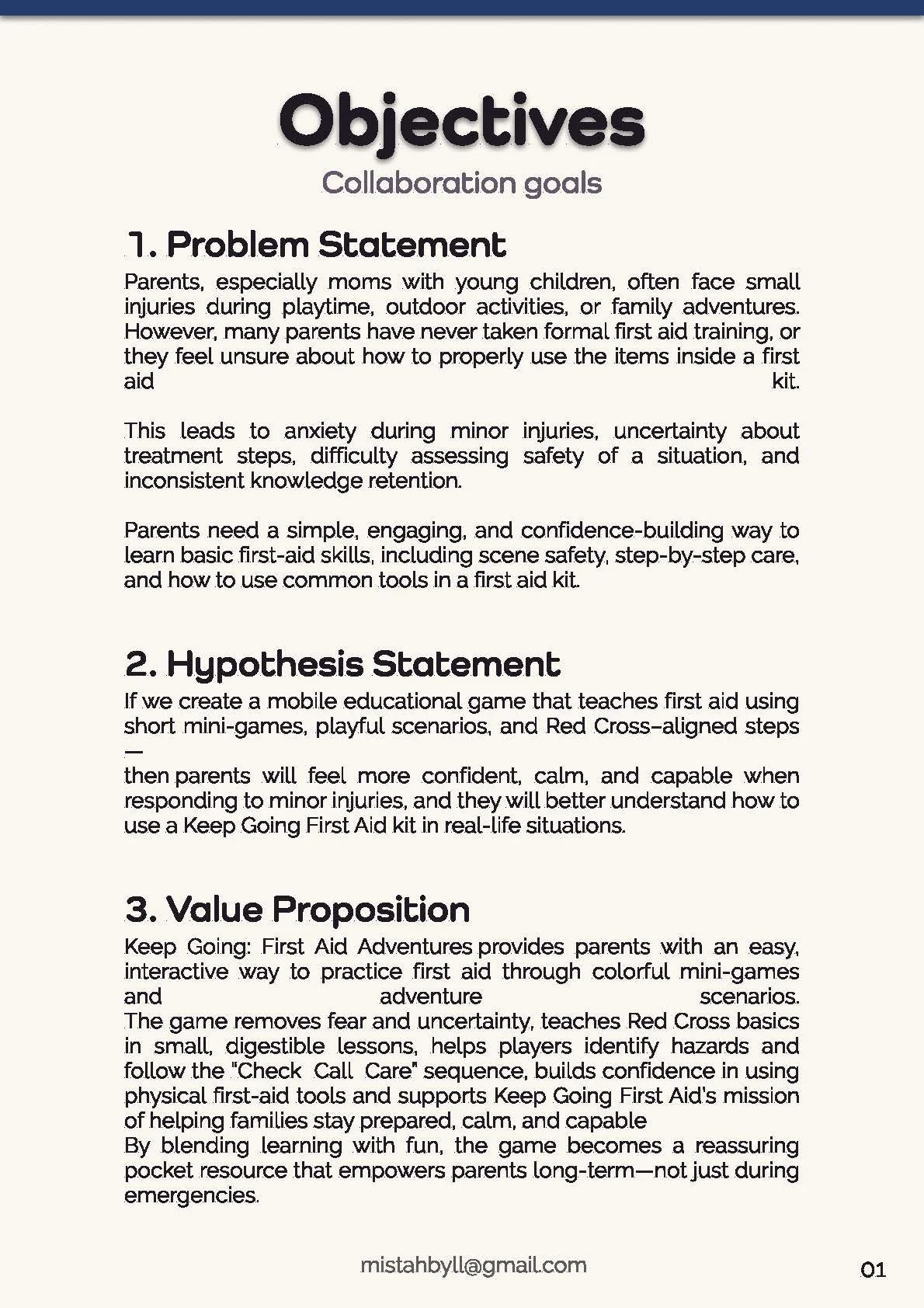
Parents, especially moms with young children, often face small injuries during playtime, outdoor activities, or family adventures. However, many parents have never taken formal first aid training, or they feel unsure about how to properly use the items inside a first aid kit.
This leads to anxiety during minor injuries, uncertainty about treatment steps, difficulty assessing safety of a situation, and inconsistent knowledge retention.
Parents need a simple, engaging, and confidence-building way to learn basic first-aid skills, including scene safety, step-by-step care, and how to use common tools in a first aid kit.
Hypothesis
If we create a mobile educational game that teaches first aid using short mini-games, playful scenarios, and Red Cross–aligned steps, then parents will feel more confident, calm, and capable when responding to minor injuries, and they will better understand how to use a Keep Going First Aid kit in real-life situations.
Here is how the proposal came out:

If you would prefer, you can download the whole proposal as a PDF here.
Week 2: USER RESEARCH & PROBLEM DEFINITION
Week 2 focused on understanding the emotional, cognitive, and practical challenges parents face when learning and applying first-aid skills. This phase emphasized research and synthesis, ensuring that the design direction for Boo Boo Heroes would be grounded in real user needs rather than assumptions.
Client
Keep>Going First Aid
Project Date:
December, 2025
School
Full Sail University
Class
UXP119-O
Research Strategy & Methods
A multi-method research approach was used to explore both functional needs and emotional pain points. Activities included persona creation, empathy mapping, journey mapping, affinity mapping, and structured ideation frameworks such as SCAMPER, Six Thinking Hats, SWOT analysis, and Like/Wish/What If exercises.
These methods helped surface not just what parents struggle with, but why. Particularly when under stress, time pressure, and uncertainty during minor injury situations.
Persona Development
Research consistently revealed that parents experience heightened anxiety during everyday injuries, often driven by fear of making the wrong decision. Many rely on quick online searches, feel overwhelmed by dense medical information, and struggle to recall correct steps in the moment.
Parents expressed a strong preference for:
Clear, visual guidance over text-heavy explanations
Simple, repeatable steps that reduce decision fatigue
Reassuring tone rather than urgent or clinical instruction
These insights reinforced the importance of emotional reassurance as a core design goal, alongside accuracy and clarity.
The primary persona, Misty Supermom, was created to synthesize research findings into a representative user profile. Misty embodies a caring, capable parent who wants to do the right thing but feels overwhelmed by uncertainty when a child is hurt. This persona guided tone, pacing, interaction complexity, and visual decisions throughout the remainder of the project.
Key Insights & Patterns
Synthesis & Problem Framing
By the end of Week 2, the project had a clearly defined user, a refined understanding of parental anxiety and behavior, and a set of validated design principles grounded in research. These insights established a strong foundation for ideation and ensured that future design decisions remained user-centered.
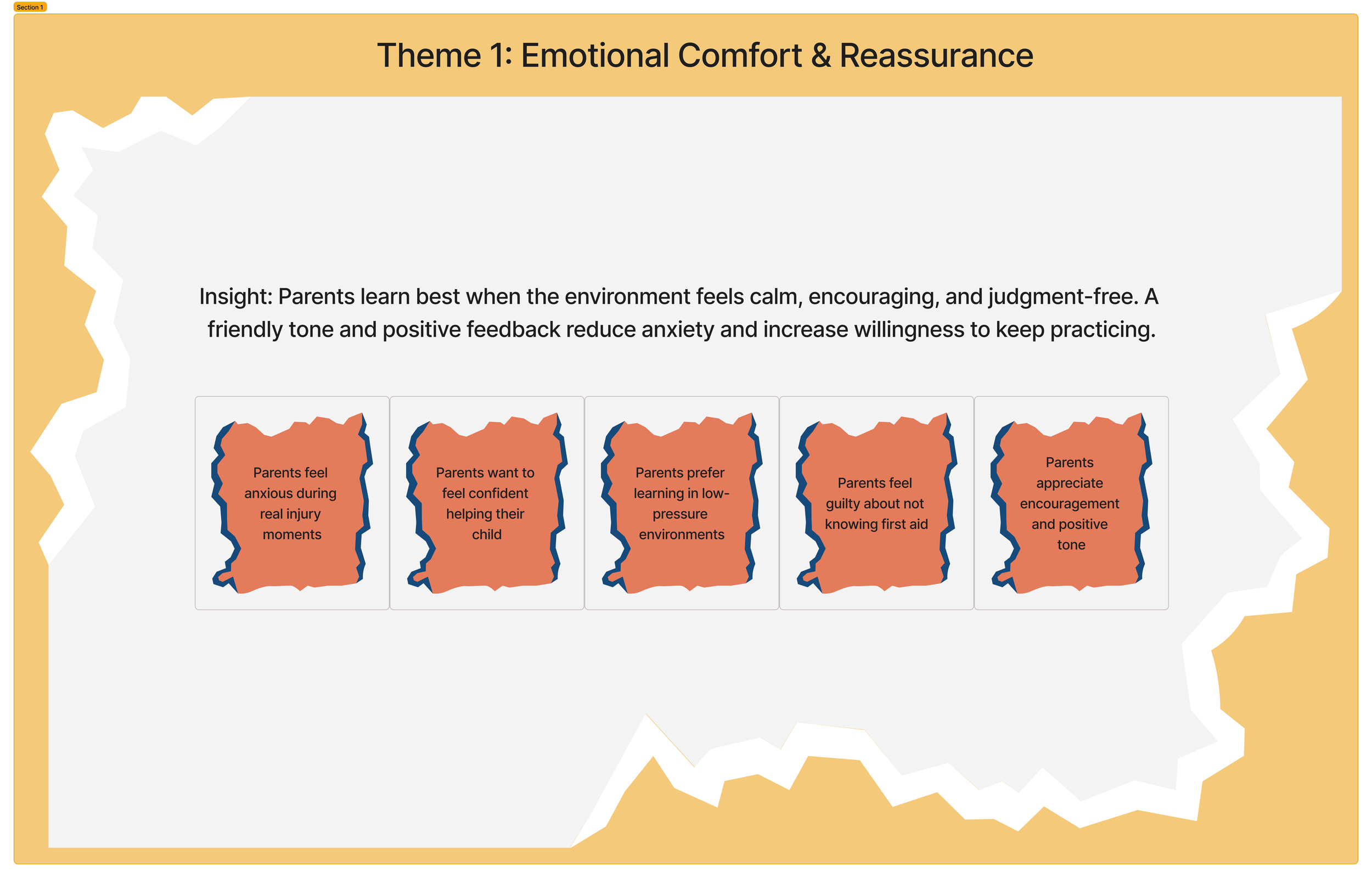
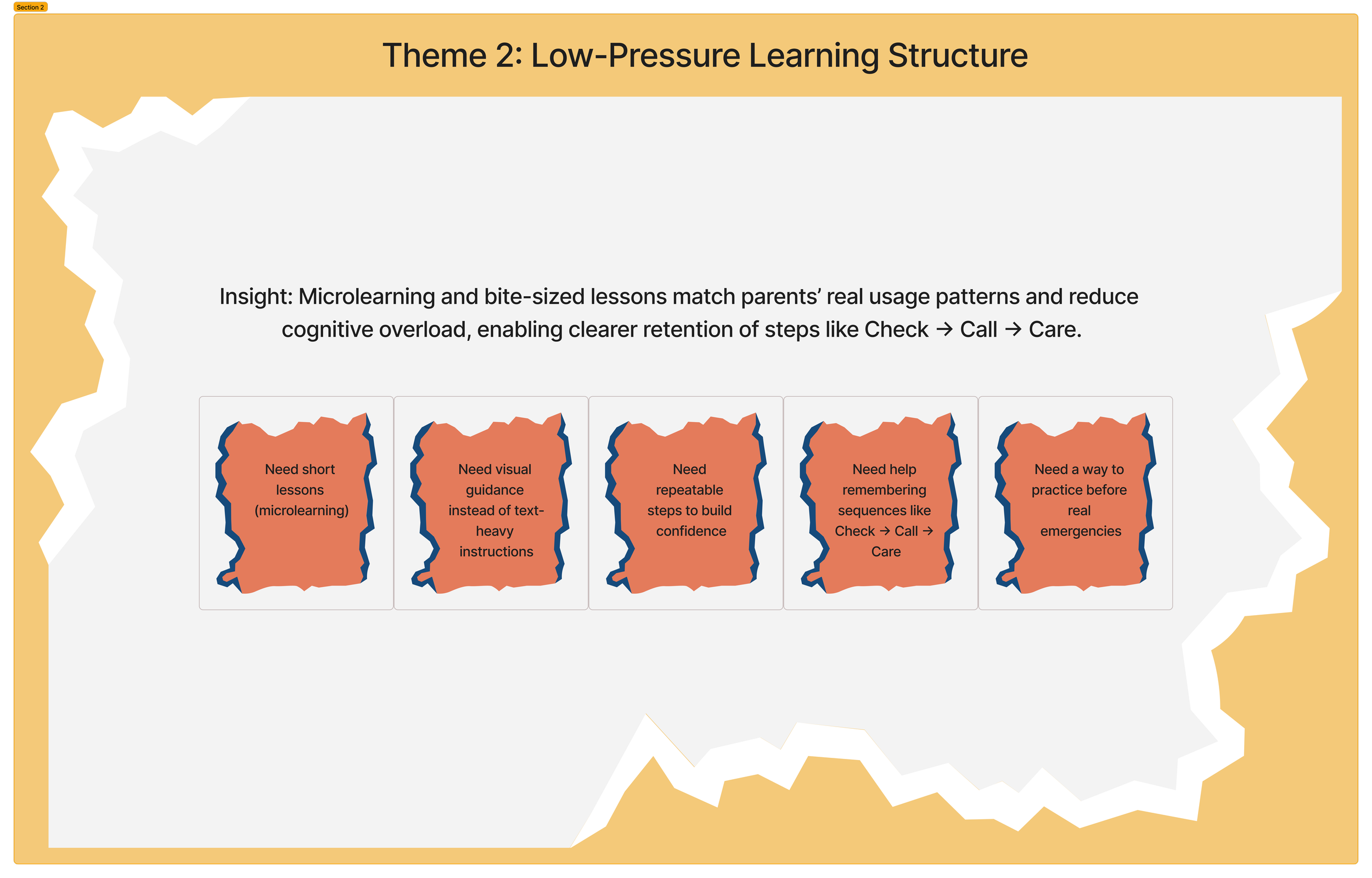
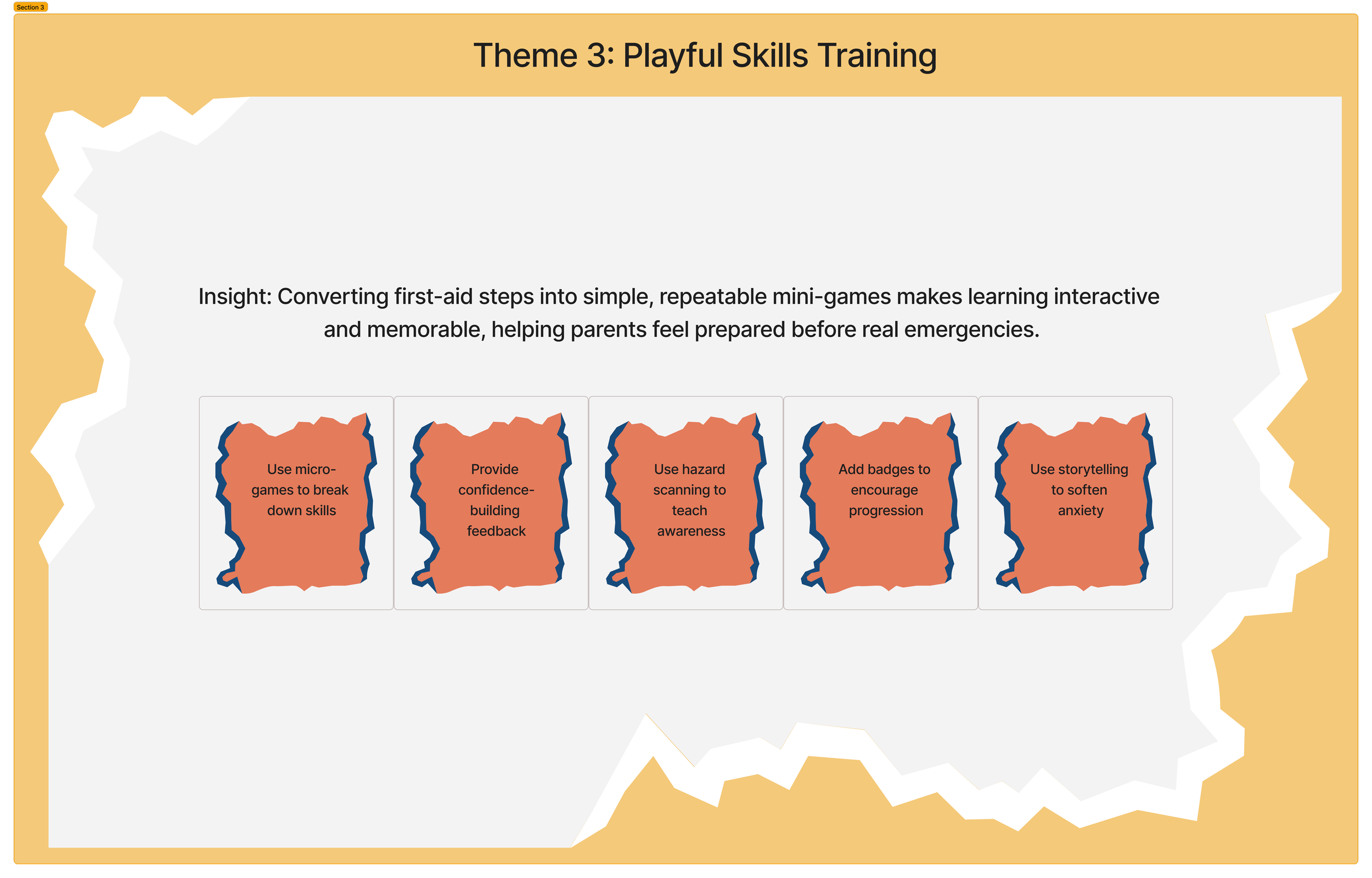
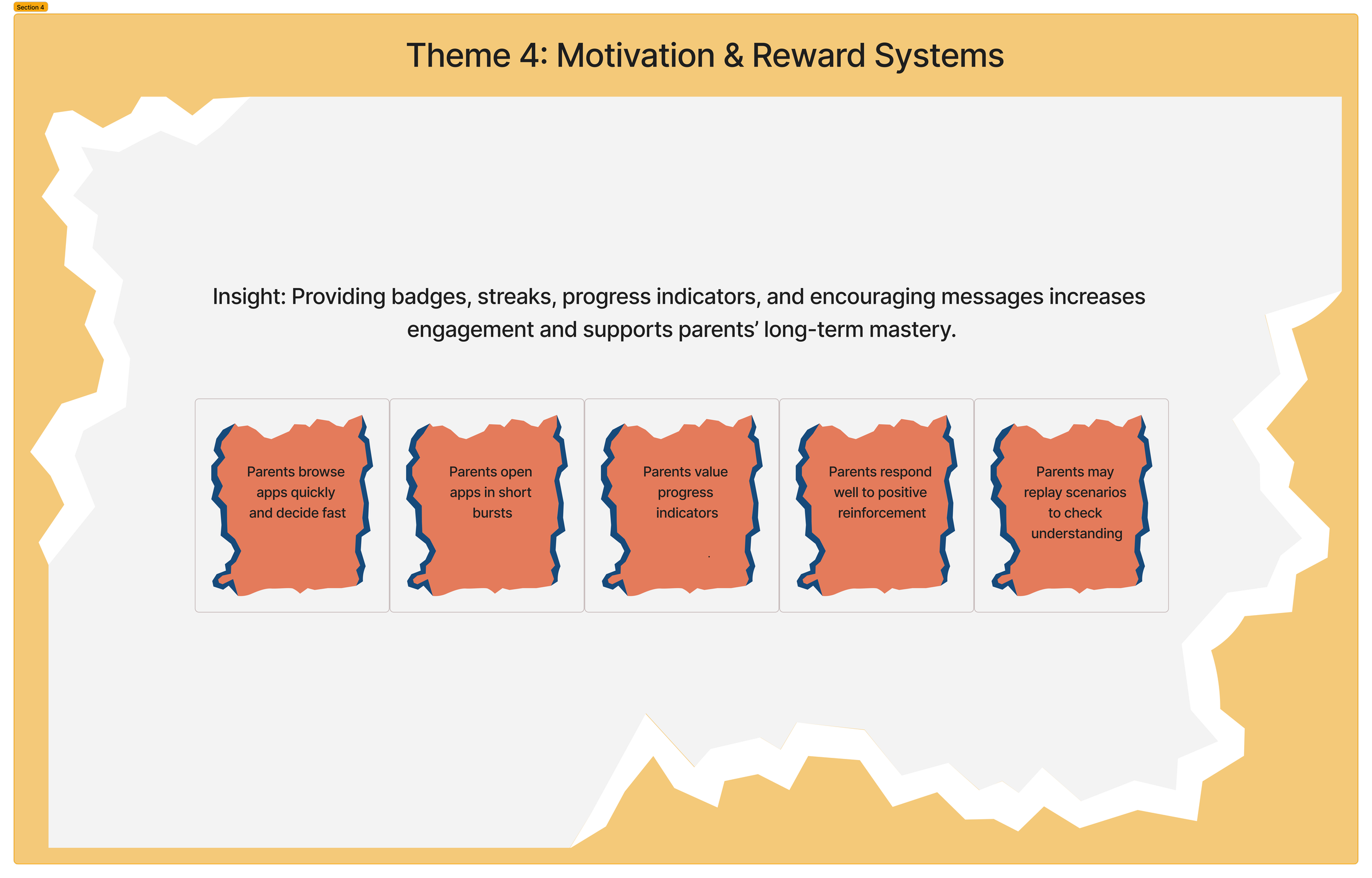
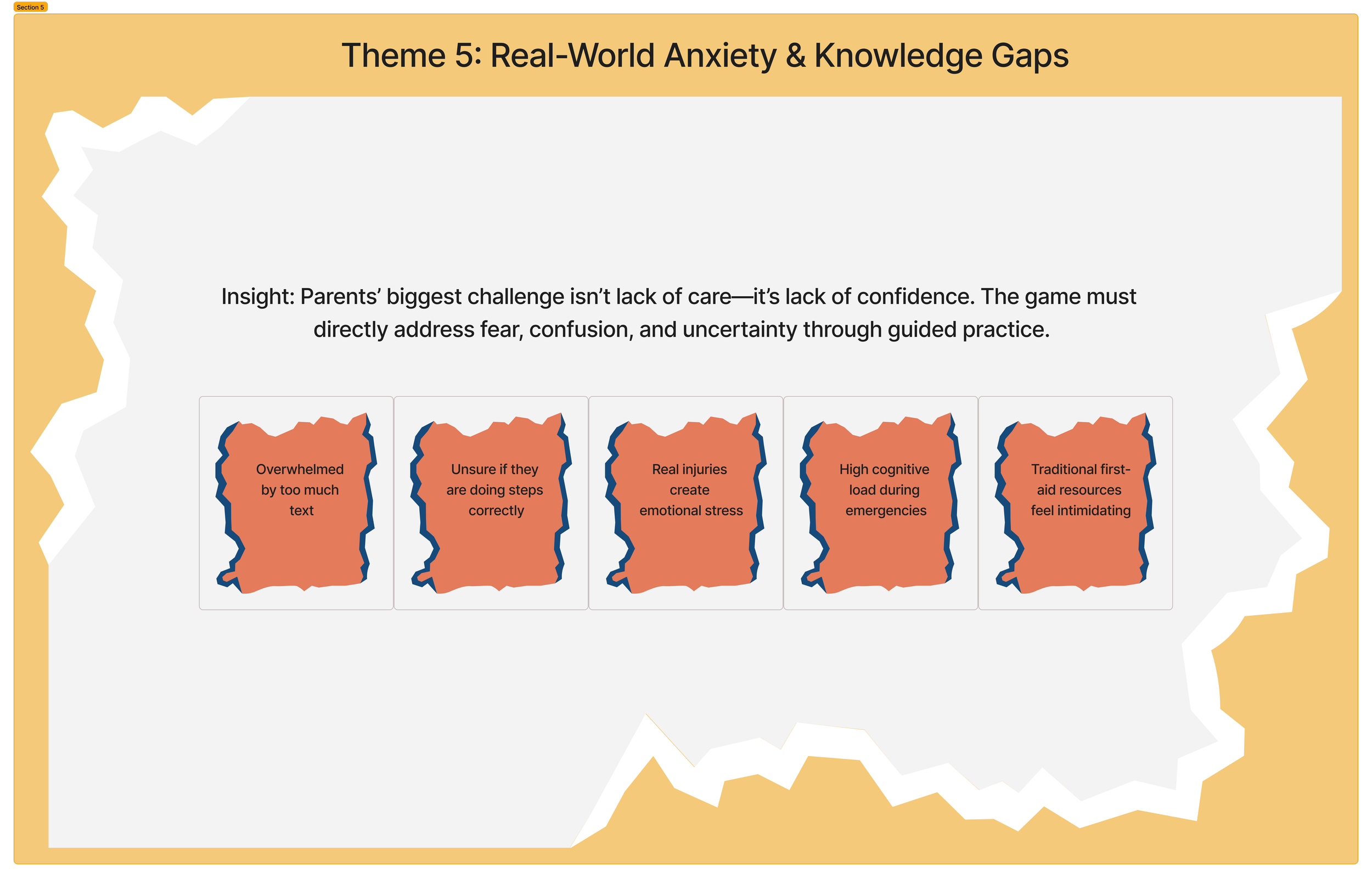
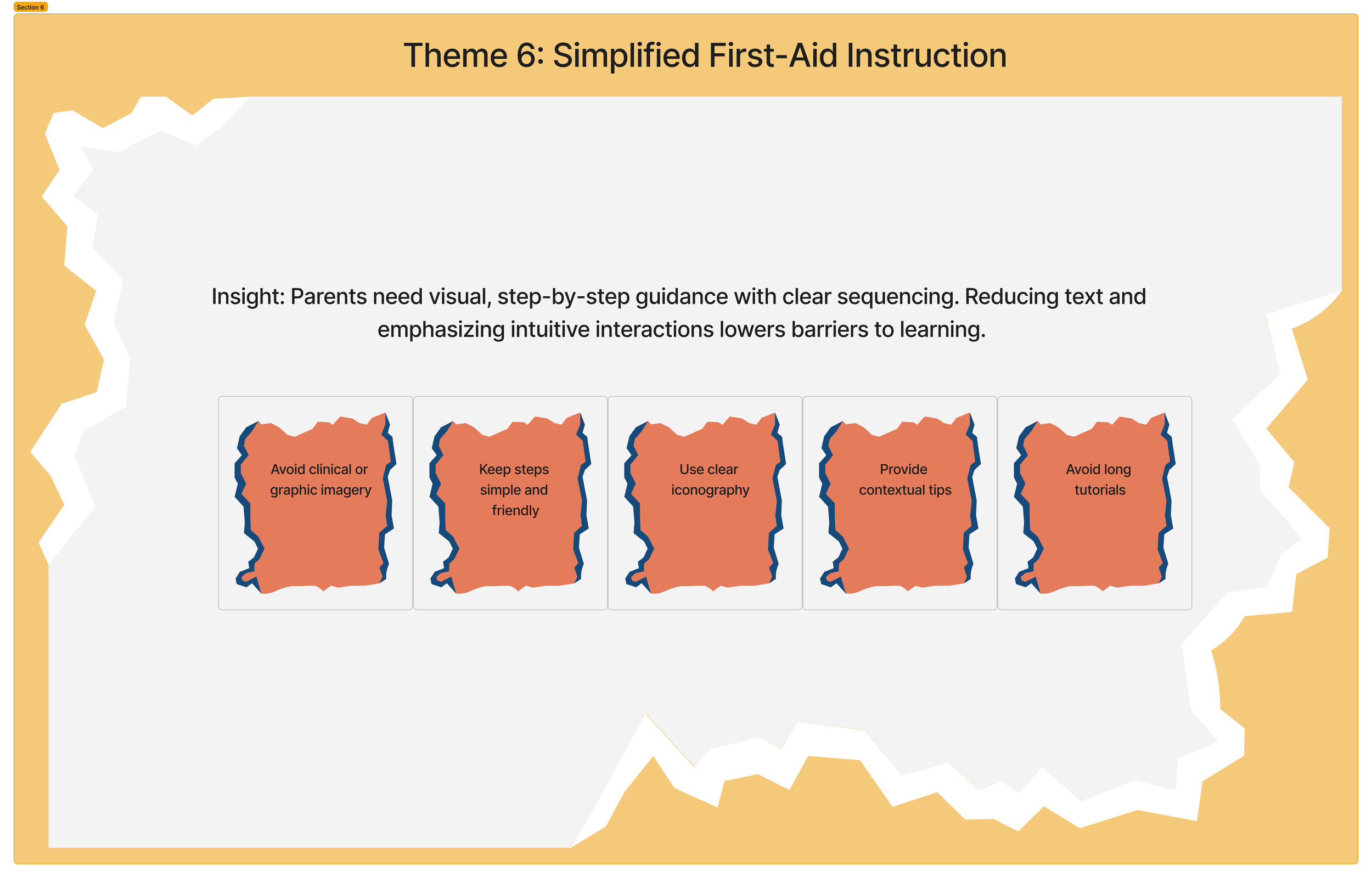
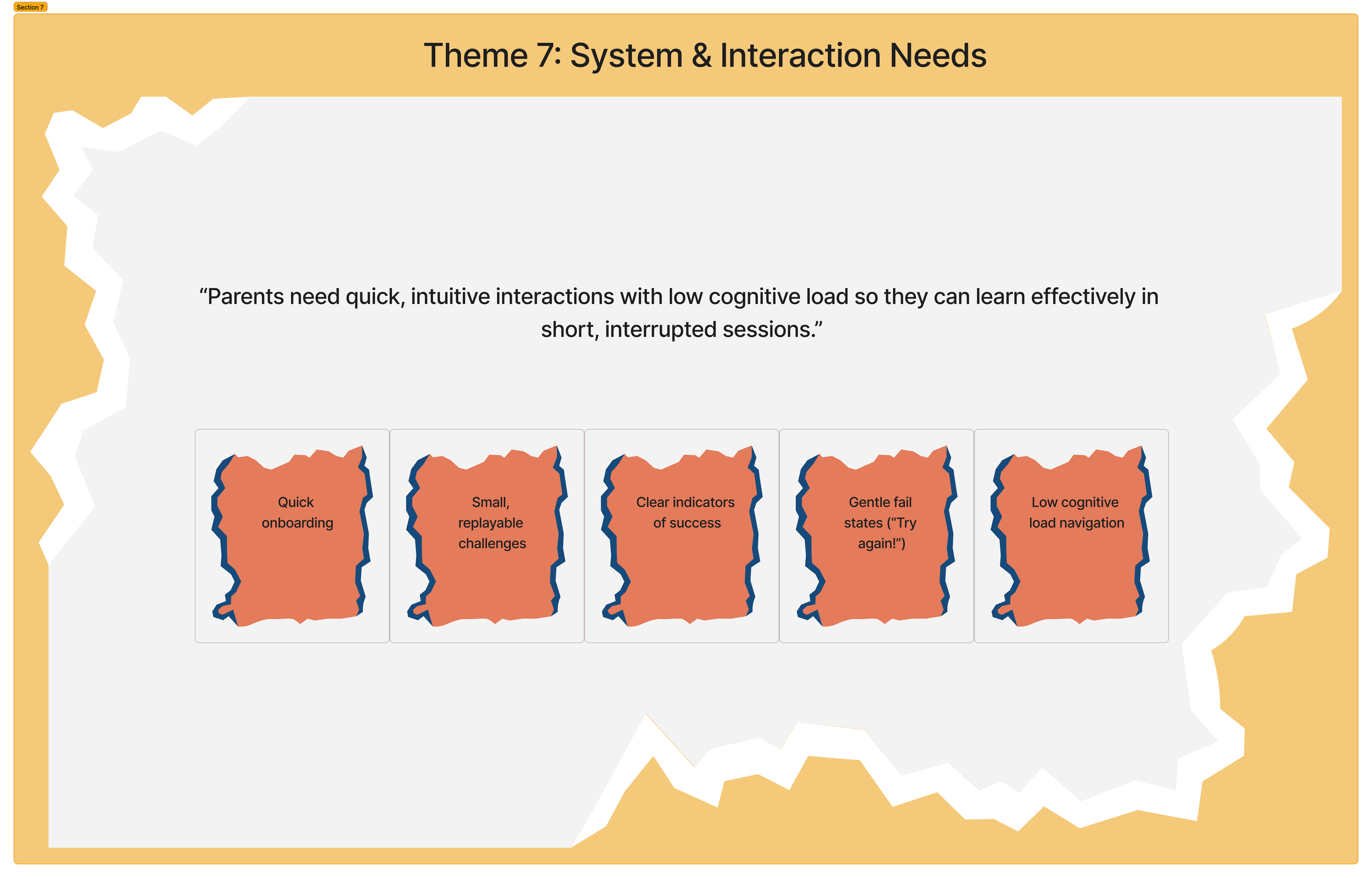
Affinity mapping revealed recurring themes, including emotional reassurance, low-pressure learning, simplified instruction, playful skill-building, and low cognitive load. These themes helped refine the core problem statement and directly informed how learning content would be structured in later weeks.
Week 2 Summary
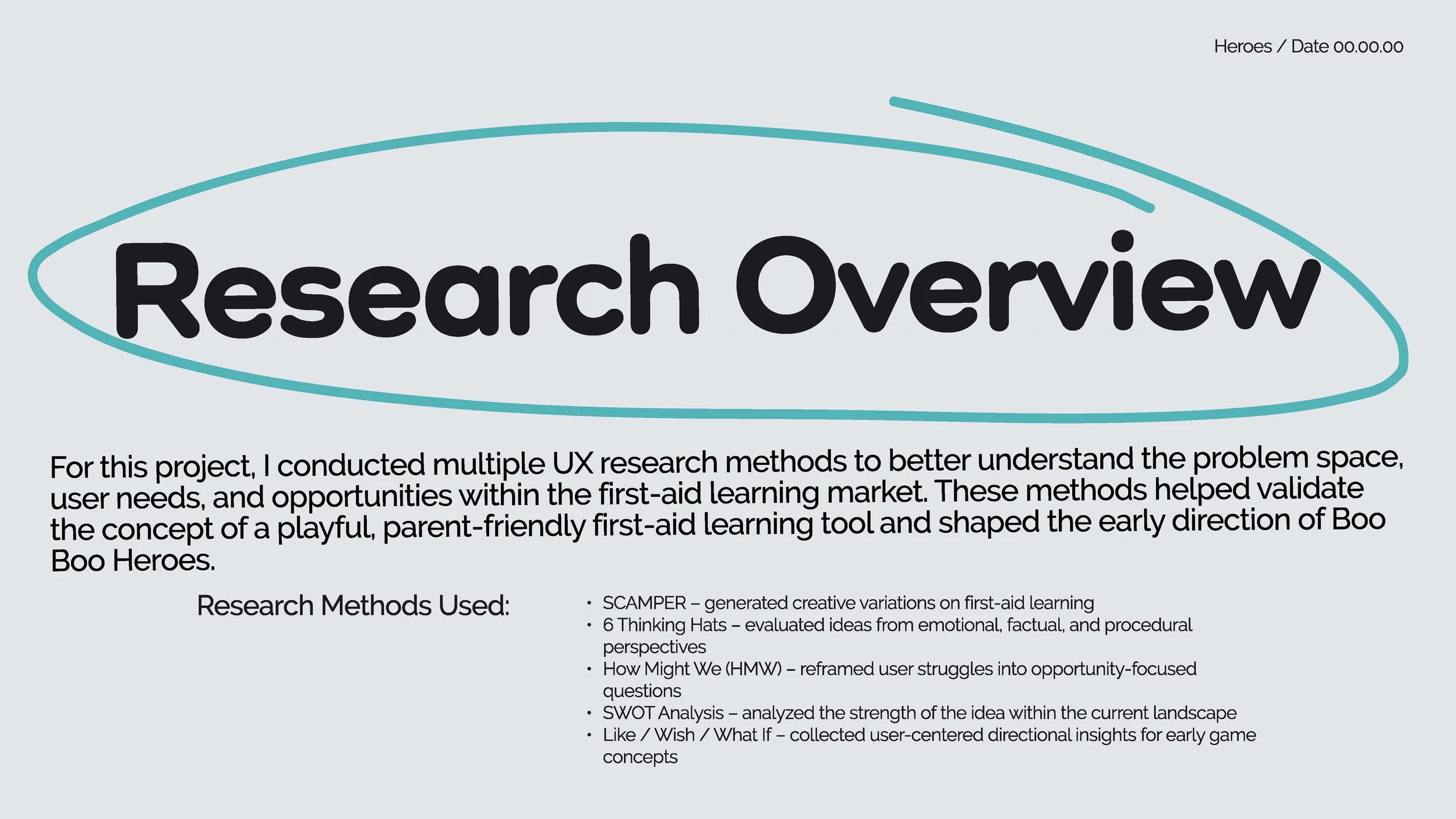
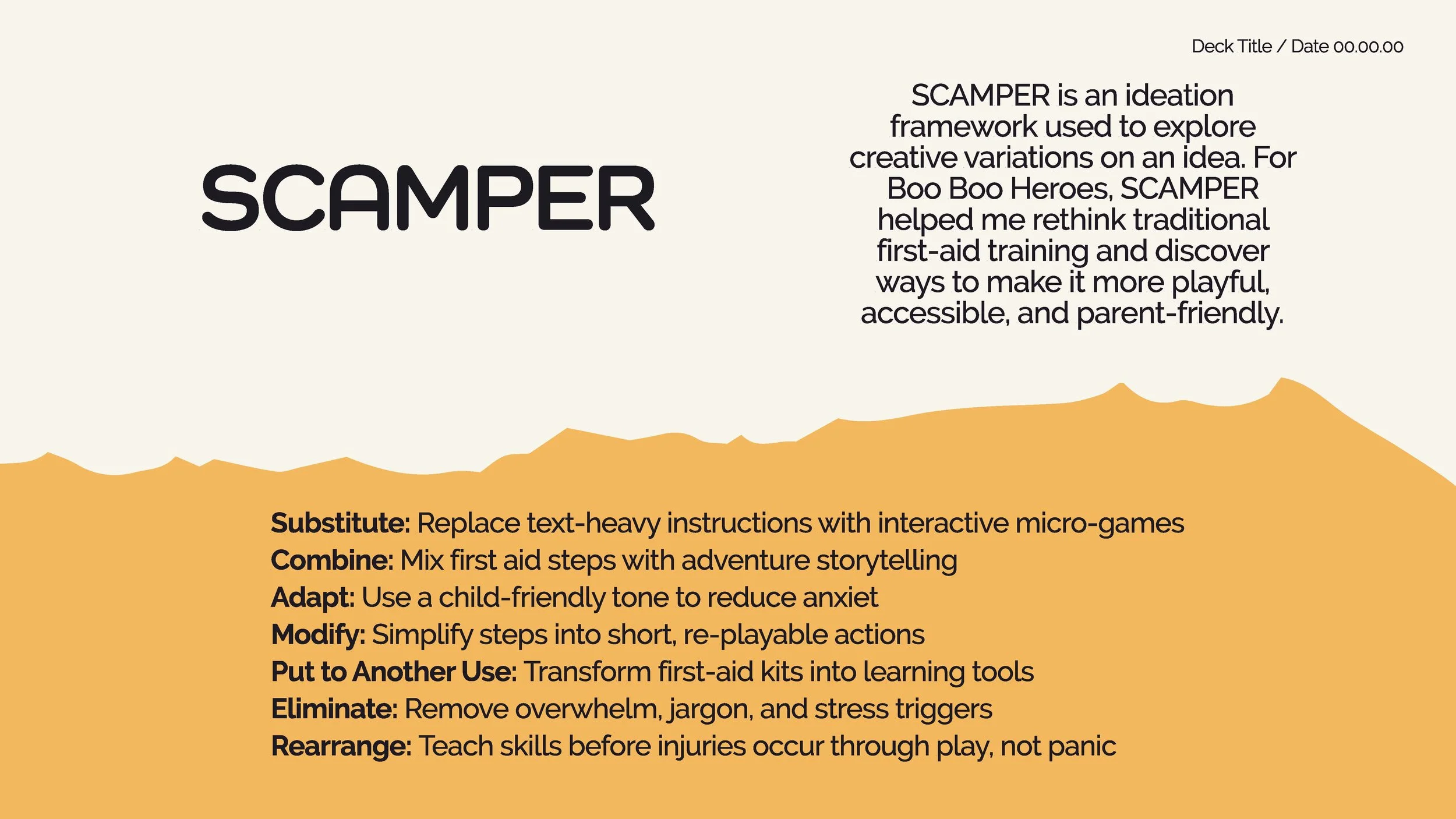
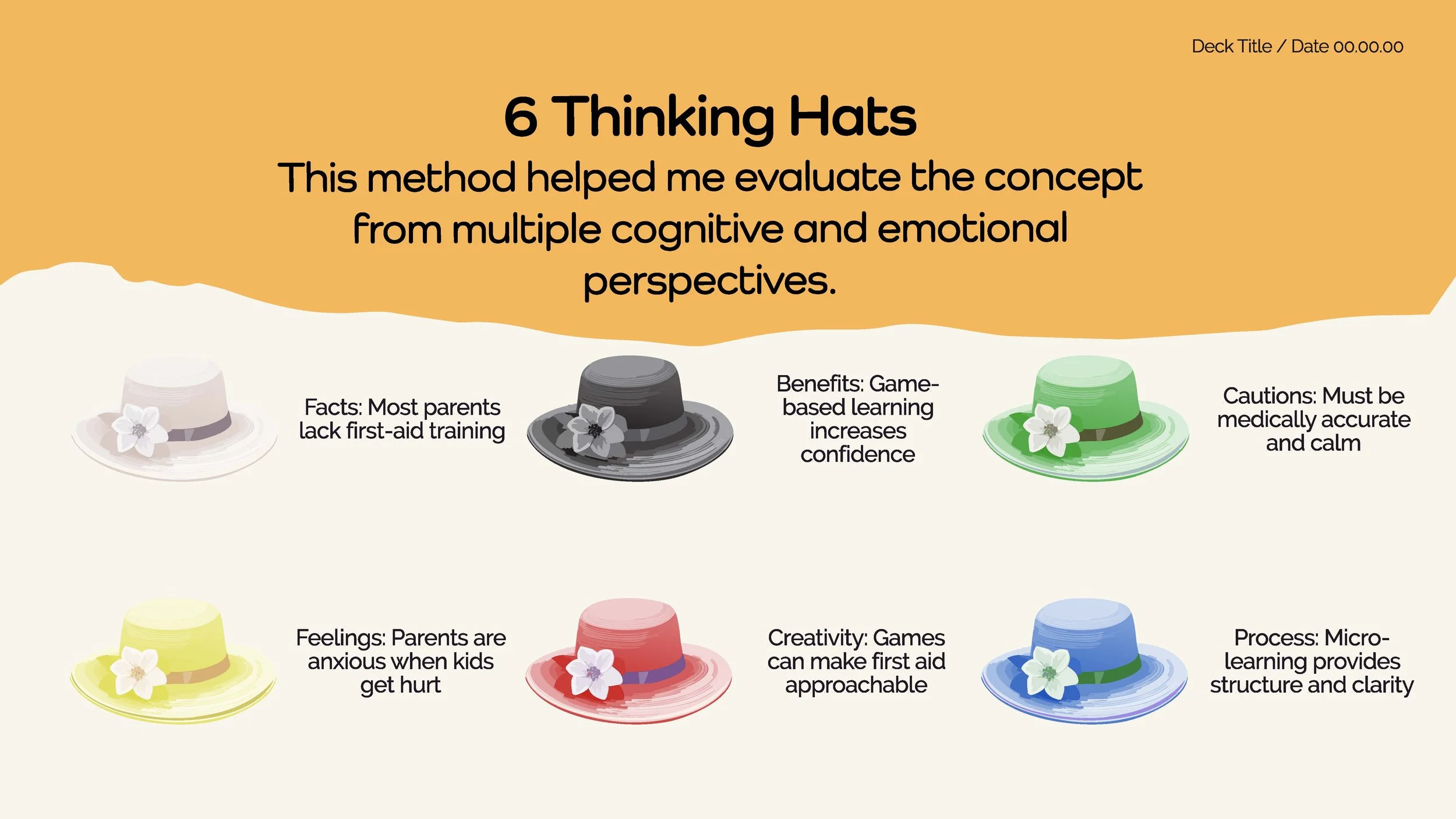
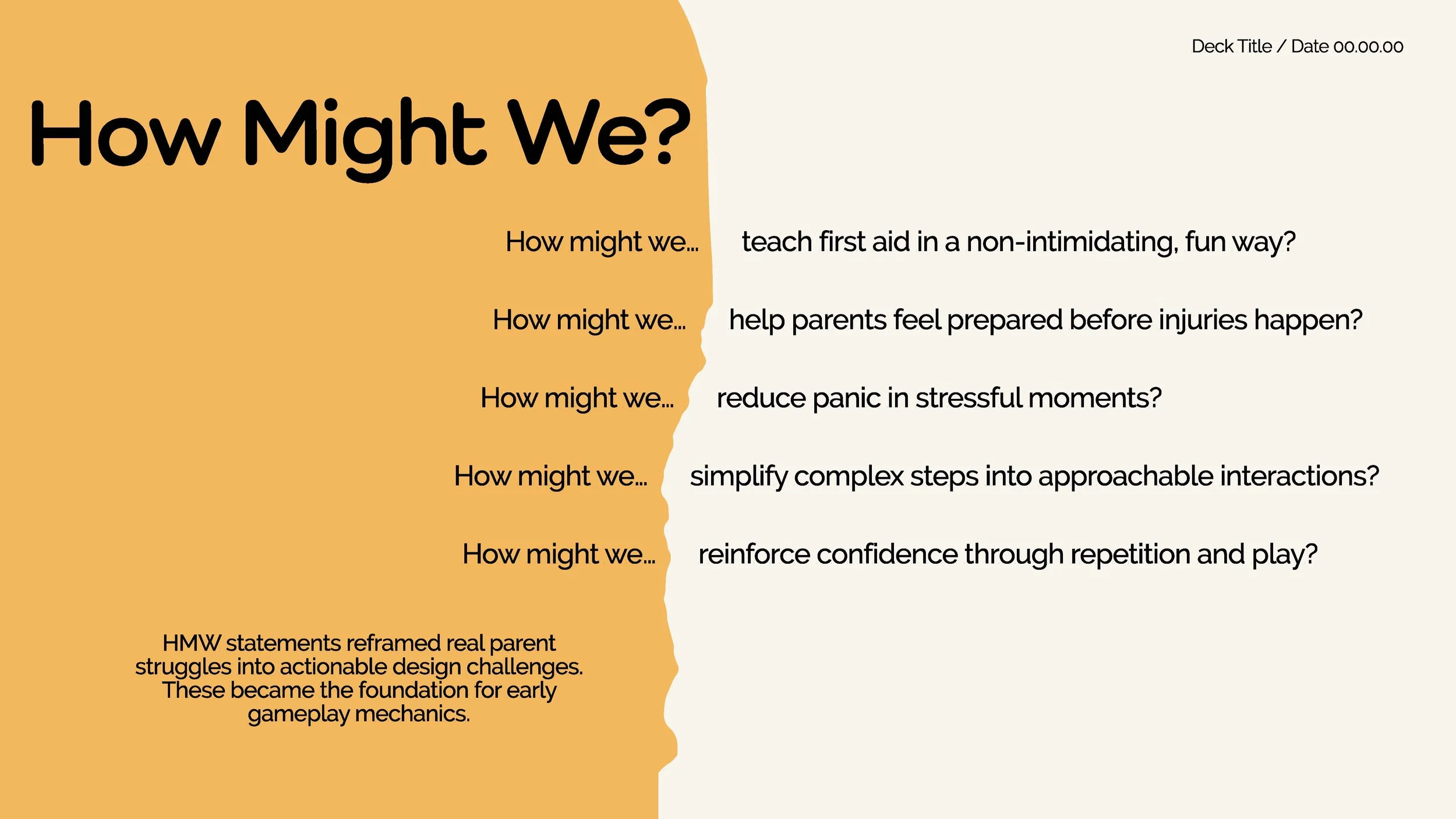
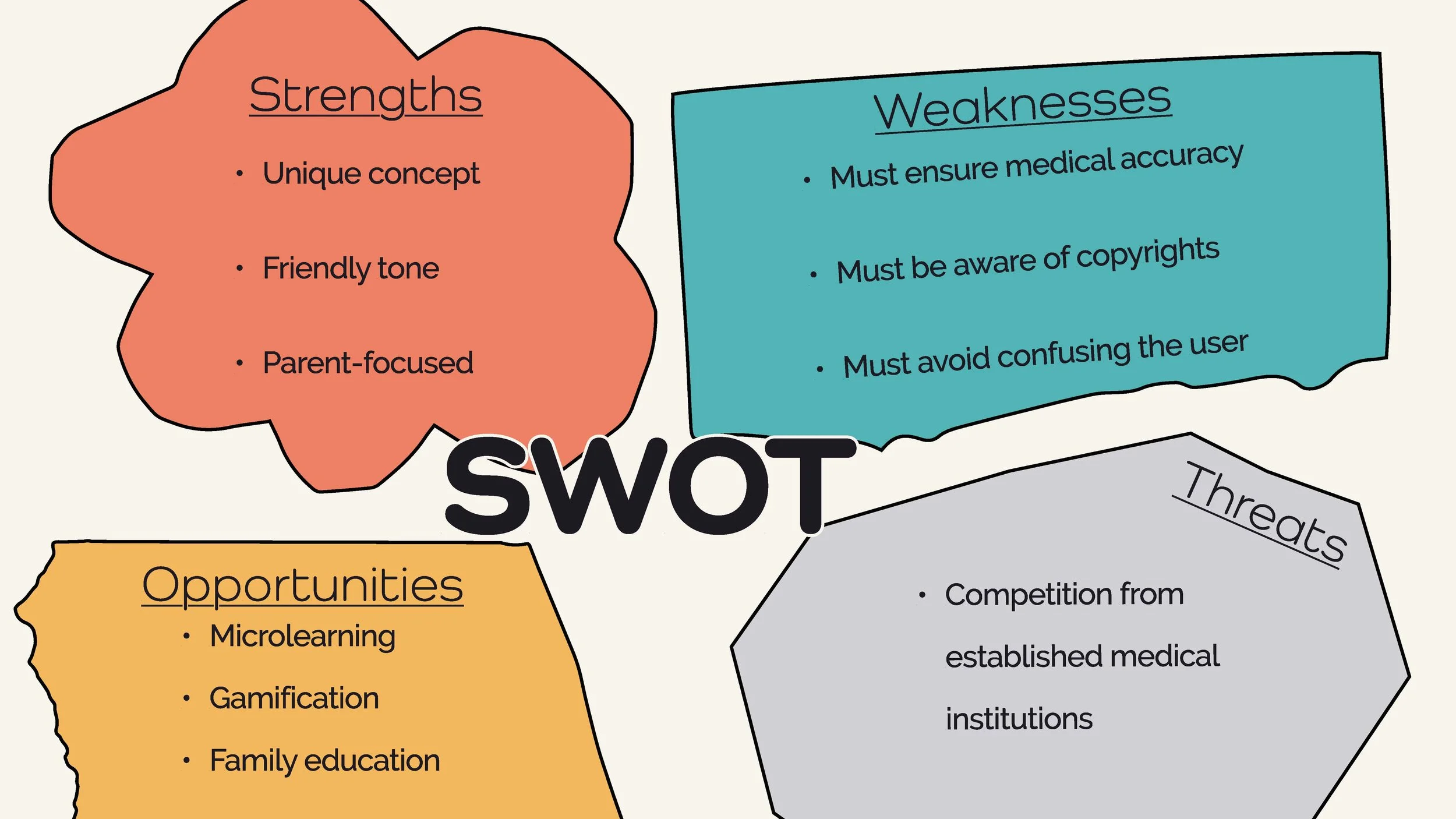
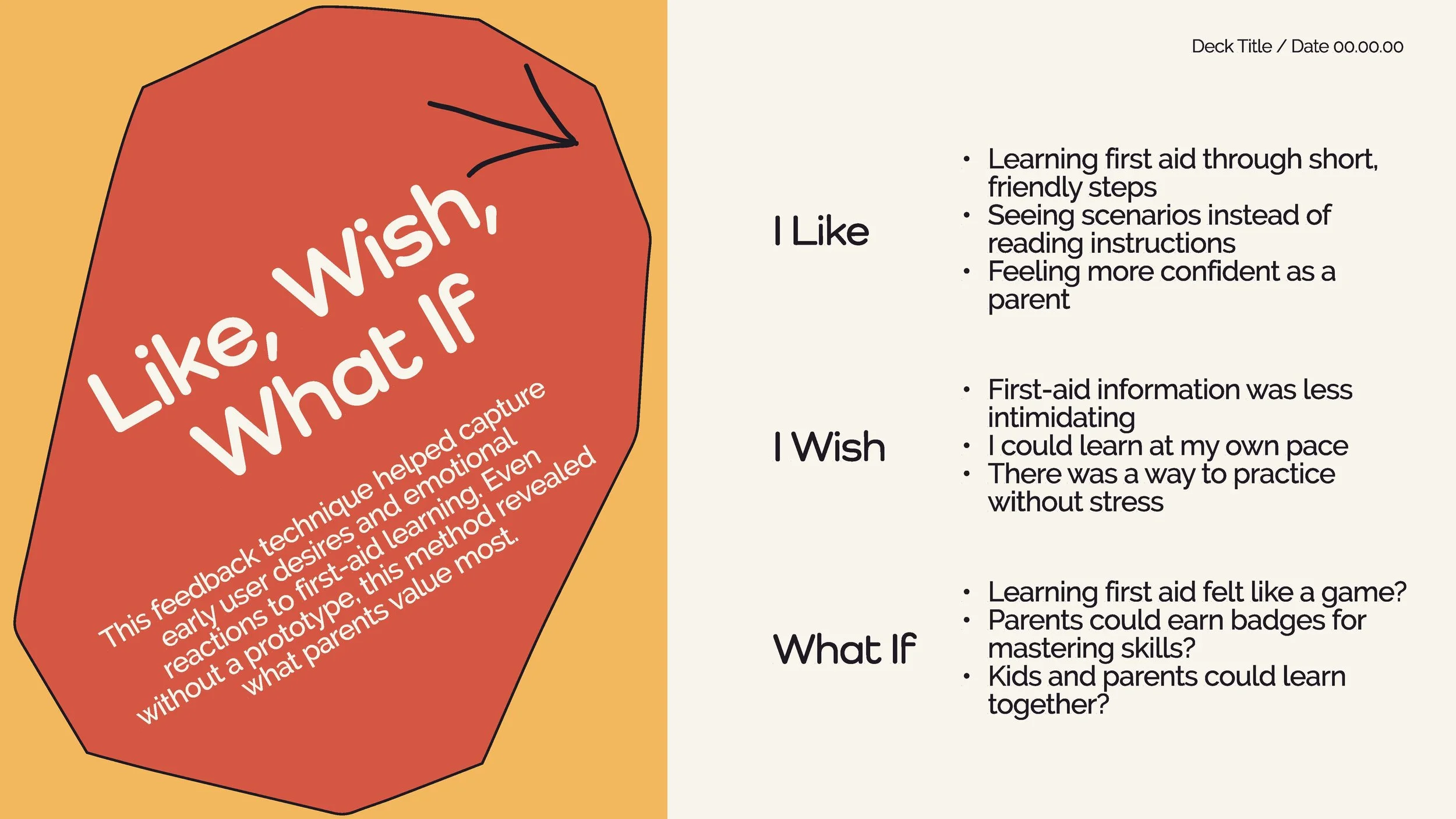
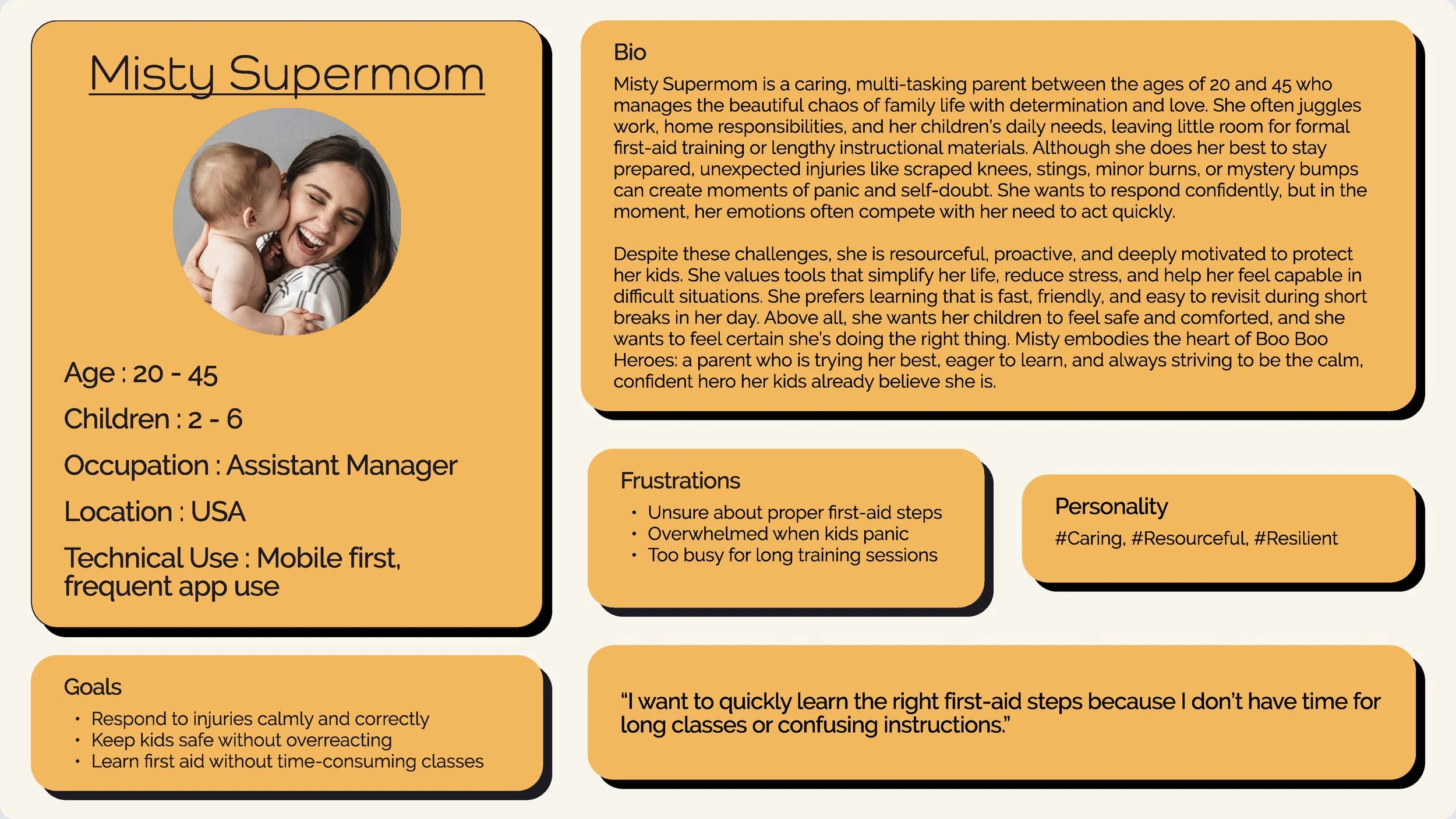
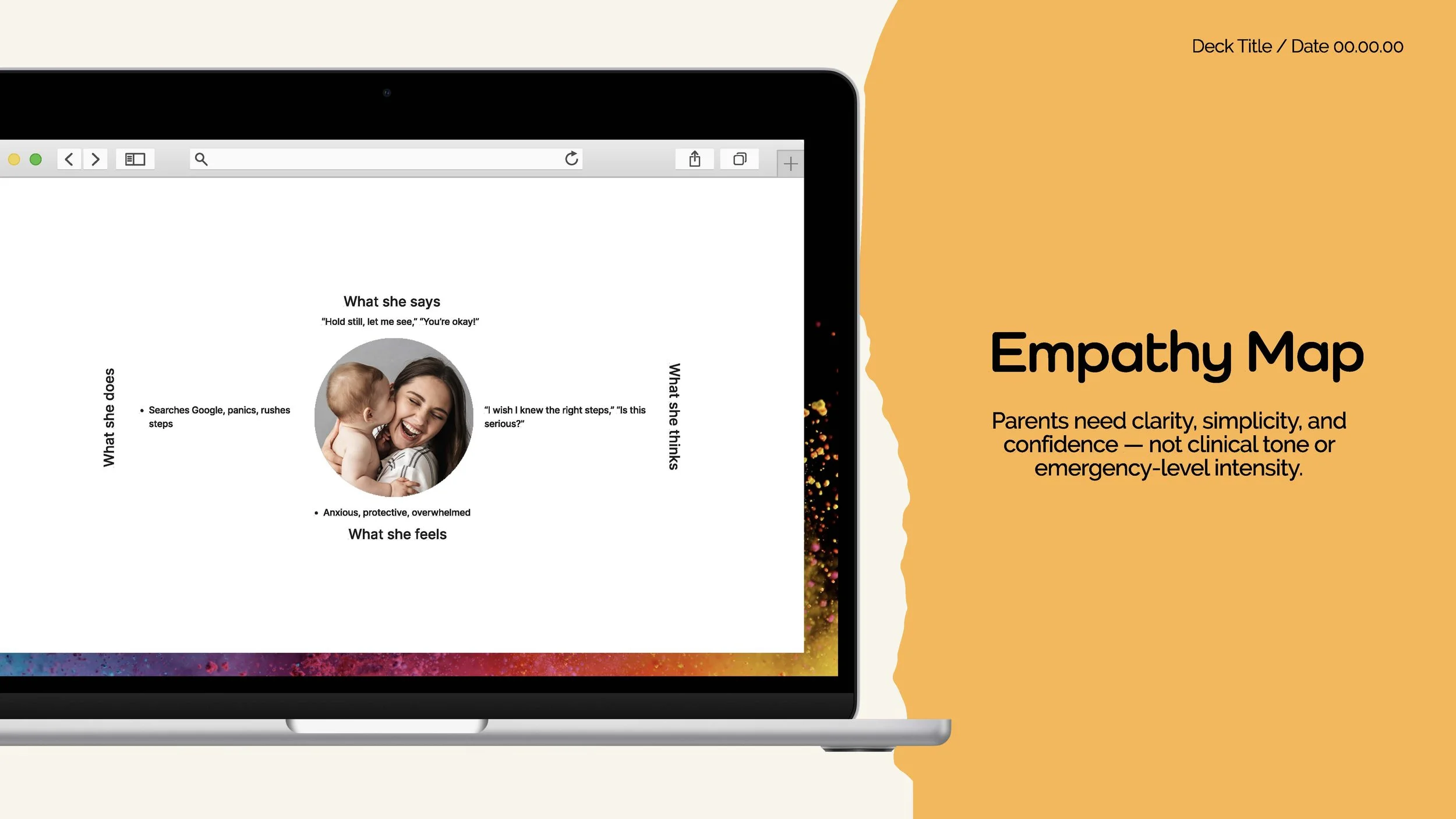
If you would prefer, you can download both my research and affinity map presentations below,
WEEK 3: IDEATION & PROTOTYPE PLANNING
Week 3 translated research insights into actionable design plans for the Boo Boo Heroes MVP. This phase focused on defining how the learning experience would function, feel, and flow, preparing a complete blueprint for prototyping in Week 4.
Client
Keep>Going First Aid
Project Date:
December, 2025
School
Full Sail University
Class
UXP119-O
A comprehensive Game Design Document was created to formalize the project’s learning philosophy, interaction model, and emotional tone. The GDD clarified that Boo Boo Heroes is a parent-focused learning game built around short, guided interactions aligned with the Check → Call → Care framework.
The document established consistency across gameplay structure, tone, visual direction, and instructional pacing, serving as a single source of truth for all subsequent design work. Click here to see the full document as a PDF.
Game Design Document (GDD)
MVP Definition & Scope
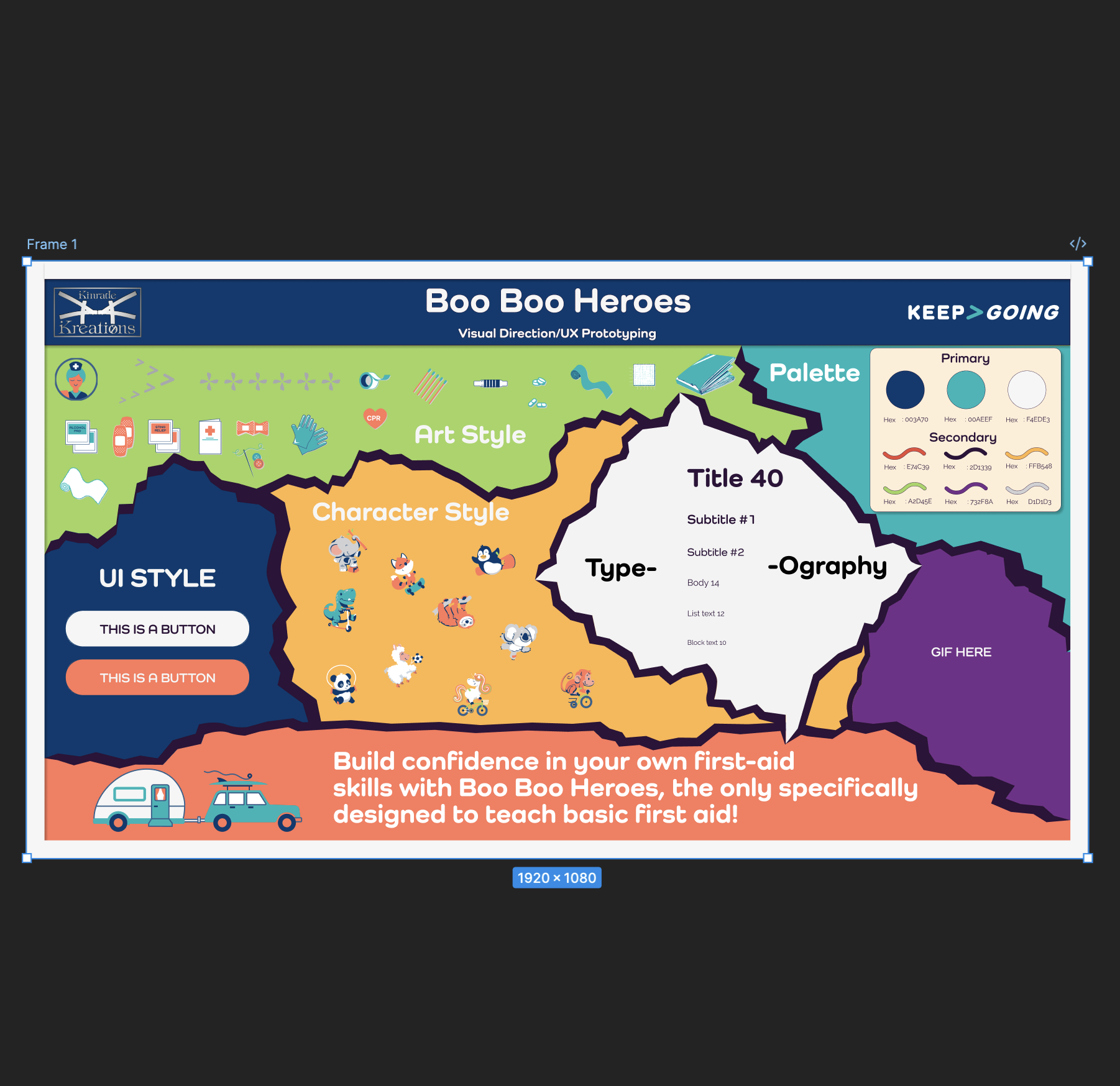
A mood board was developed to guide the look and feel of the prototype, emphasizing calm color palettes, symbolic illustrations, readable typography, and UI patterns inspired by health and wellness tools. These choices supported emotional reassurance and reduced cognitive load.
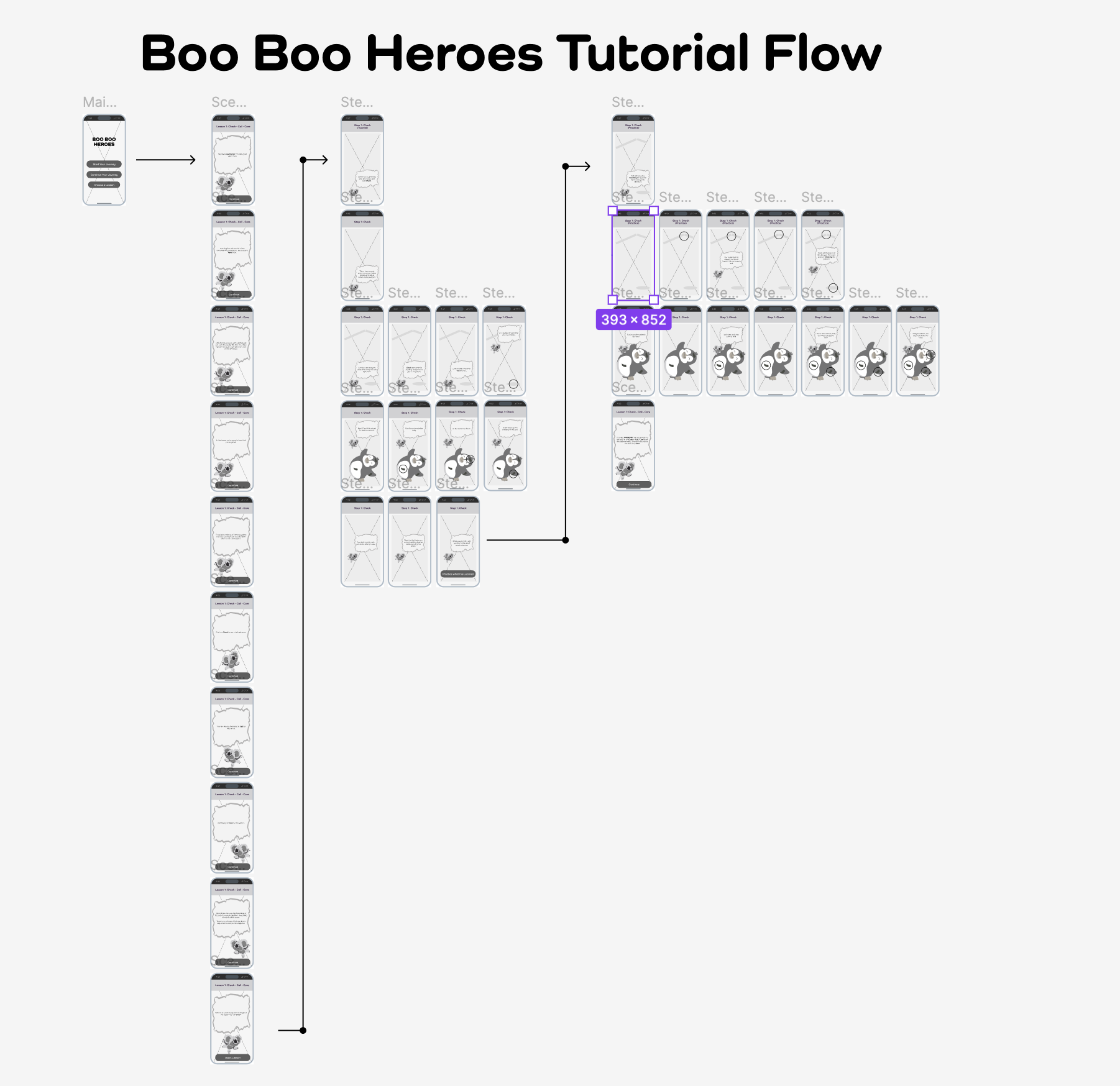
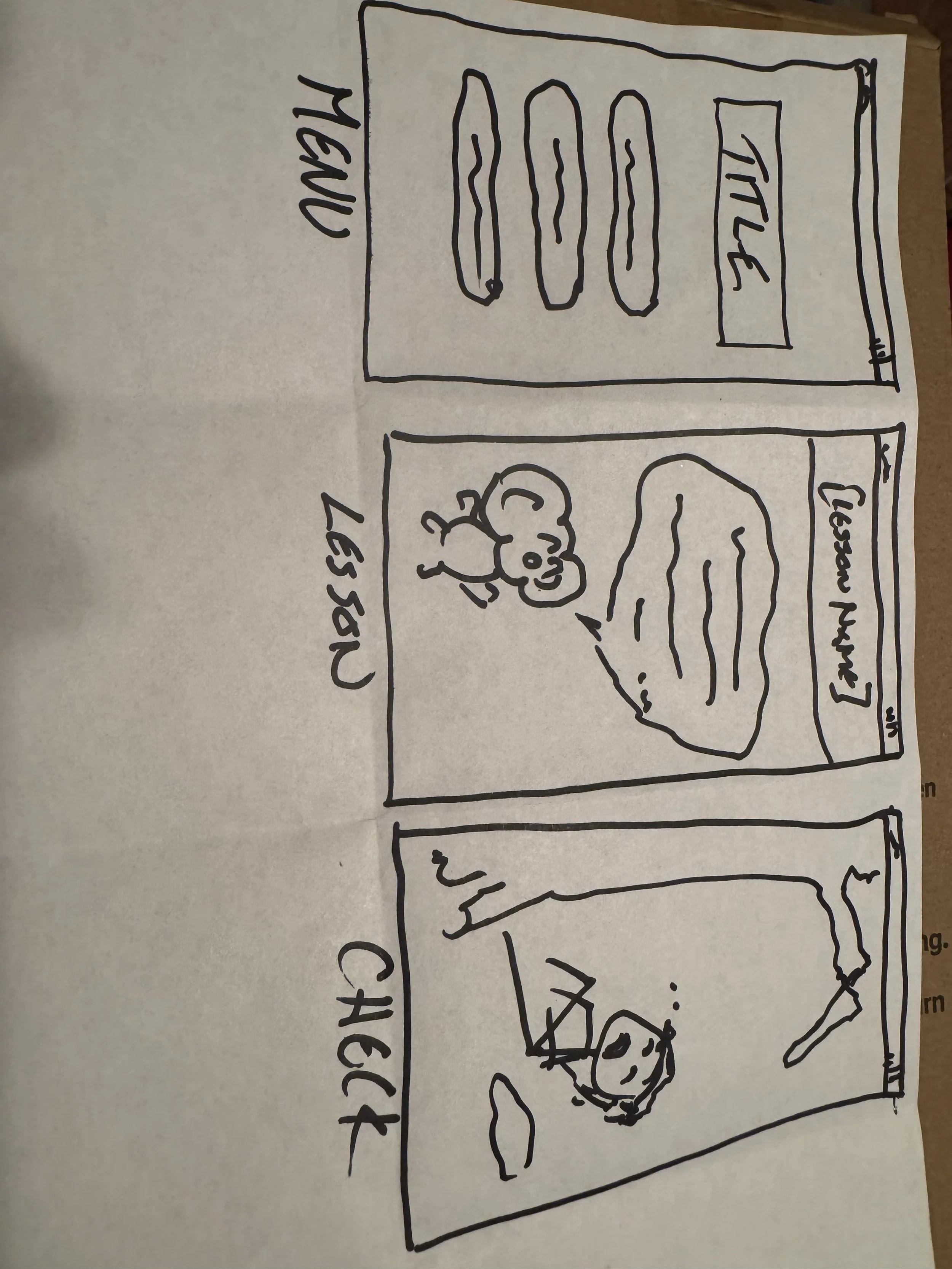
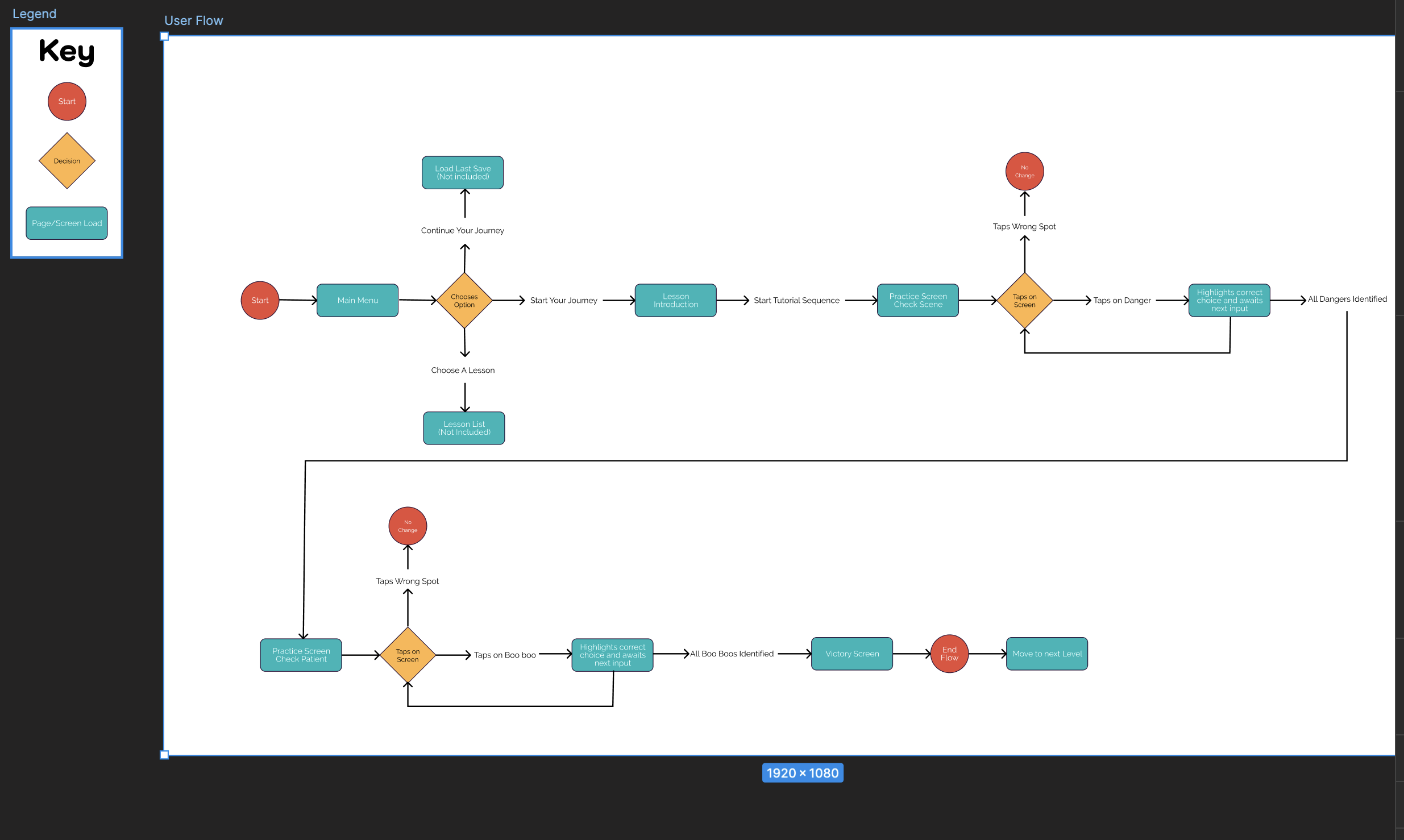
In parallel, detailed user flows and high-fidelity wireframe specifications were documented. These defined screen content, microcopy tone, interaction rules, feedback states, and asset requirements, ensuring consistency during prototyping.
The MVP was intentionally scoped to include one complete training scenario, allowing the core learning loop to be tested without unnecessary complexity. This flow included a main menu, scenario introduction, guided Check, Call, and Care steps, and a clear completion moment.
This approach ensured the prototype would demonstrate learning effectiveness, emotional tone, and interaction clarity within a manageable scope. Click here to see the full MPV document as a PDF.
Visual Direction & UX Planning
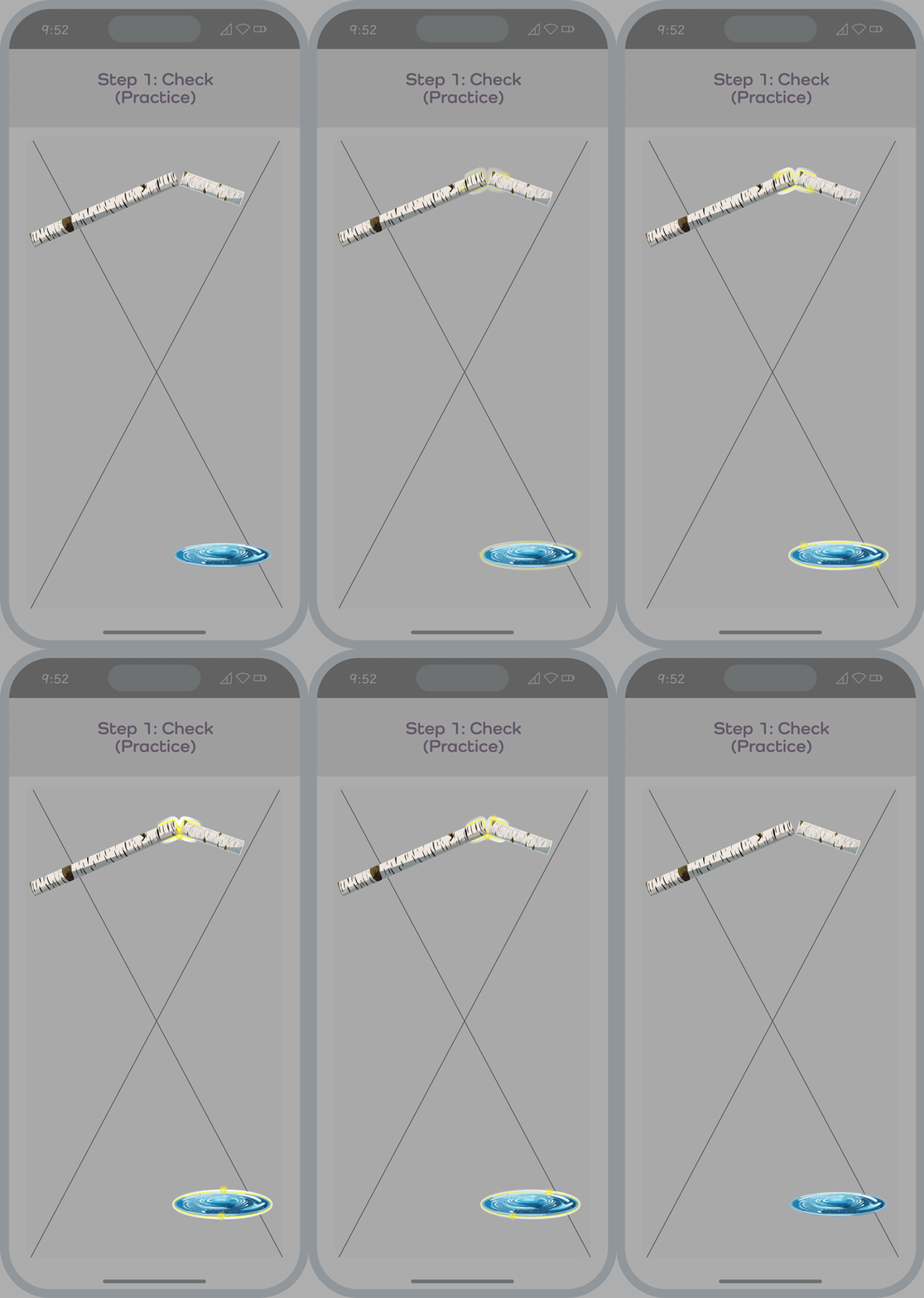
An instructional animation concept—later referred to as the Soft Visual Focus Cue—was designed to gently guide user attention during interactions. Rather than decorative animation, this microinteraction supports clarity and confidence, reinforcing correct behavior without distraction.
Week 3 Summary
Microinteraction & Animation Planning
By the end of Week 3, all major design decisions were documented and validated against research findings. The project now had a clear MVP structure, visual language, interaction logic, and instructional approach, fully preparing it for hands-on prototyping.
WEEK 4: IDEATION & PROTOTYPE PLANNING
Week 4 focused on transforming planning and documentation into a tangible, interactive experience. This phase brought Boo Boo Heroes to life through a high-fidelity prototype built in Figma and evaluated how effectively it supported calm, confidence-building learning.
School
Full Sail University
Class
UXP119-O
Client
Keep>Going First Aid
Project Date:
December, 2025
Interactive Prototype Development
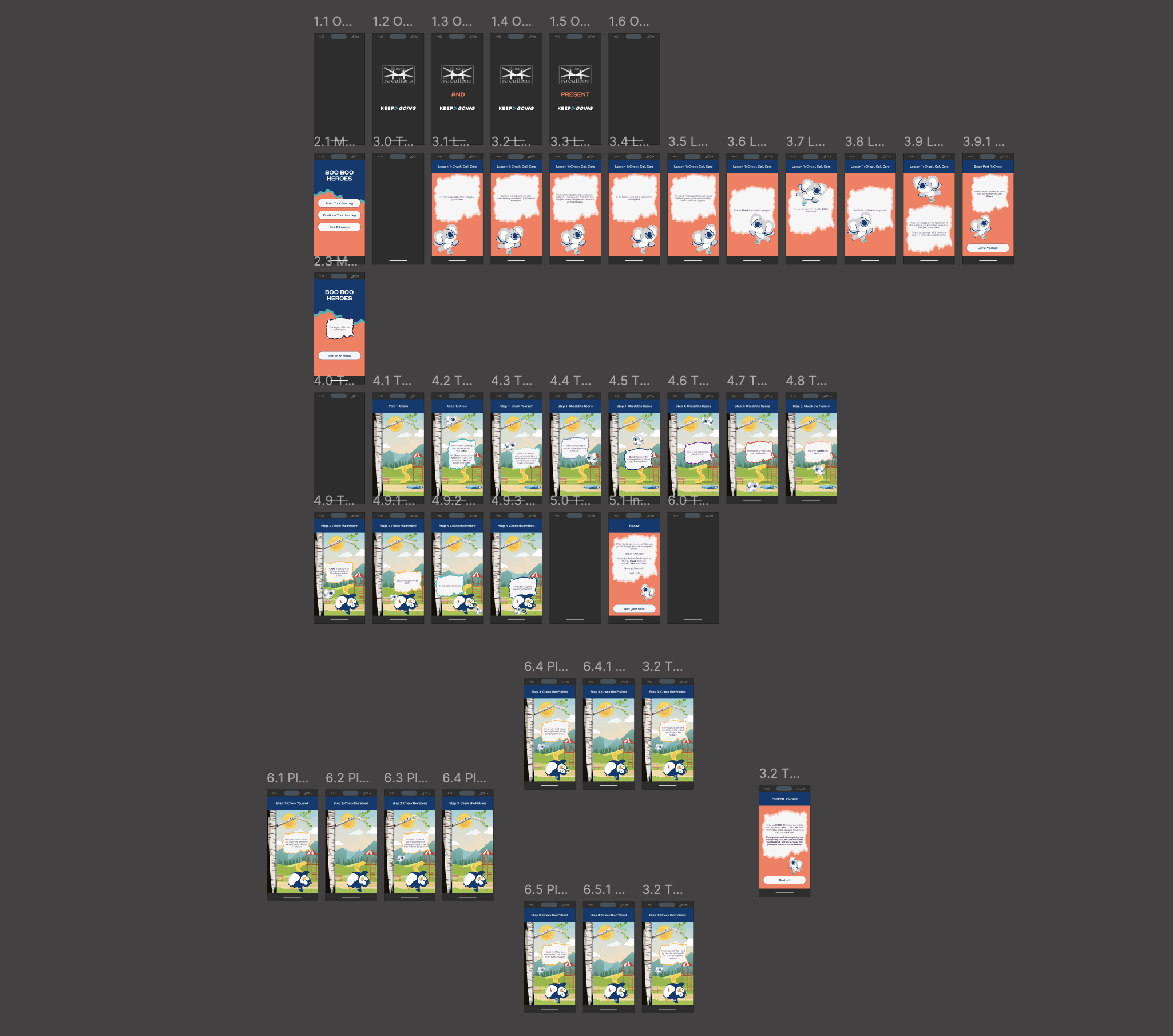
Using the wireframe specifications and visual direction from Week 3, a fully interactive prototype was constructed in Figma. The prototype included conversational onboarding, animated guidance cues, and hands-on interactions for each step of the Check → Call → Care sequence.
Care was taken to ensure interactions felt intuitive, friendly, and low-pressure, reinforcing the project’s learning philosophy through motion, pacing, and tone.
Usability Testing & Validation
Basic usability testing was conducted to assess clarity, flow, and emotional response. Feedback focused on whether users understood what to do next, felt supported rather than rushed, and could complete the lesson without confusion.
Testing validated the importance of conversational guidance, visual focus cues, and simple interactions in reducing hesitation and increasing confidence.
Week 4 Summary
By the end of Week 4, Boo Boo Heroes existed as a cohesive, research-informed interactive prototype. The project successfully demonstrated how UX design, game-inspired learning, and emotional consideration can work together to support parents during everyday first-aid moments.
And here it is, the culmination of a full month’s work. I proudly present to you:
BOO BOO HEROES
Tap the corner arrows to enter full screen mode. Press Escape to exit full screen.
Feel free to try this in its native format on Figma. It looks and plays particularly well on mobile with this method. Mobile Users please click the link below.
Click Here to be taken to the Figma Prototype
Case Study Summary
Boo Boo Heroes began with a simple goal: make first-aid learning feel calmer, friendlier, and more approachable for parents. Over the course of this project, that goal evolved into a fully realized, research-driven mobile learning experience built in collaboration with Keep Going First Aid. By focusing on emotional reassurance as much as instructional clarity, the project reframed first aid as something parents can practice with confidence rather than fear.
Throughout the four-week process, each design phase intentionally built on the last. Early project framing and proposal work established a clear direction and shared vision. Research and synthesis uncovered the emotional realities parents face during minor emergencies, revealing anxiety, hesitation, and information overload as key barriers to effective action. These insights shaped the core learning philosophy of the game: simple steps, gentle guidance, and repeatable practice centered around the Check → Call → Care framework.
Ideation and planning transformed those insights into a structured experience, defining the MVP scope, user flows, visual direction, and interaction patterns. The final week brought those plans to life through a high-fidelity interactive prototype in Figma, allowing ideas to be tested, refined, and evaluated as a cohesive system. The resulting prototype demonstrates how playful, game-inspired UX can support serious learning without becoming overwhelming or clinical.
This project reinforced the value of designing for emotional context, not just functional outcomes. By prioritizing clarity, warmth, and confidence-building at every step, Boo Boo Heroes shows how thoughtful UX design can help parents feel prepared for everyday moments that matter. The case study represents both a complete design process and a foundation for future expansion into additional lessons, testing, and real-world deployment.